



🛒 Christmas shopping in Sweden: shopping malls, outlets, and cozy little shops
🎯 Introduction: why even go Christmas shopping in Sweden
Christmas shopping in Sweden is not just fridge magnets, postcards, and “something symbolic.” In winter it’s very easy to combine pleasure with practicality here: buy useful gifts (clothes, shoes, accessories), pick up something for your home and interior in Scandi style, and grab a few foodie surprises — coffee, tea, sweets, spices for glögg, and nice kitchen gift sets. And shopping is woven into the overall winter atmosphere: lights, window displays, Christmas décor, and music in malls and on the streets.
This article will be especially useful for:
tourists who fly in for just 2–7 days and don’t want to waste half a day on the “wrong” kind of shopping;
expats and students who need to quickly get oriented on where to buy gifts for family and colleagues;
those who deliberately combine a trip with shopping and want to know in advance where to go for what.
The main idea is simple: in Sweden, Christmas shopping lives in three worlds at once — big shopping malls, outlets, and small shops/design boutiques in the city center. They’re very different in atmosphere, prices, and results. Once you understand how one format differs from another, you won’t run around between malls and little streets for nothing — you’ll be able to plan routes so you can buy what you need and enjoy winter Sweden.
🗺 The big picture: where Christmas shopping “lives”
In pre-Christmas Sweden, shopping is spread across three “worlds,” and each of them offers its own kind of experience:
Large shopping malls
They exist in Stockholm, Gothenburg, Malmö and other big cities, as well as outside them — near highways and transport hubs. Inside is the familiar mix: clothing, shoes, electronics, cosmetics, sports, kids’ stores, a food court.
This is the choice if you need:
an indoor, warm space without wind, rain, or snow;
to “buy everything at once” in one go;
shopping that’s not so much atmospheric as it is practical.
Outlets and shopping villages
Most often they’re located outside the city and require a separate trip. They bring together brands with discounts, past-season collections, and lots of shoes, clothing, plus sports and outdoor brands.
This is the “a whole day for shopping” format:
there’s a chance to save money on well-known brands;
but you need to allow time for the trip, walking between pavilions, and the weather — which can be unpredictable in winter.
Small shops and design studios in the city center
This is exactly the kind of shopping many people imagine when they think of “Scandinavian style”:
small interior/home décor boutiques;
local clothing and jewelry brands;
studios with ceramics, textiles, candles, posters.
There’s less practical “value for money” here, but maximum atmosphere and uniqueness.
In terms of how it feels, the difference is roughly this:
a shopping mall is universal, predictable, practical: it could stand in almost any European city;
an outlet is “tactical” shopping: you go there for specific items and discounts;
a city center with little shops is about strolling, inspiration, and those details you bring home and remember for years.
Next in the article, we’ll break down each of these worlds separately, so it’s clear where to go for gifts, where to go for discounts, and where to go for the mood.
🛍 Shopping malls: convenient, warm, predictable
A Christmas shopping mall in Sweden, at first glance, looks very similar to what many of us are used to: string lights, big trees in the atrium, seasonal window displays, music, discounts, and crowds of people with shopping bags. The difference is in the details: more light and space, less aggressive “empty-your-wallet” pressure, more tidy displays and a calmer rhythm — even in December’s rush.
This is an option for those who want to solve shopping “under one roof”: in one place you can buy gifts for kids, something practical for yourself, cosmetics, electronics, a couple of things for the home — and also eat at the food court or in a café. In winter this is especially valuable: you don’t freeze while moving between streets, and you’re not dependent on rain or wet snow.
Pros of shopping malls in winter:
- everything is nearby: clothes, shoes, electronics, books, toys, gift sets, a supermarket;
- no need to think about the weather — it’s bright, dry, and warm inside;
- often a longer shopping day: in December many malls stay open longer than usual, especially on weekdays before Christmas;
- convenient if you’re tired of walking around the city and want “one clear spot” for a couple of hours.
Cons:
- the Christmas atmosphere here is more “universal” than specifically Swedish;
- it’s easy to get the “I could be in any European city” effect — there’s little local flavor;
- if you spend the whole day in a mall, you might not really feel the winter city outside.
How to fit shopping malls into your route:
Stockholm
A good scenario is not to start with a mall, but to use it for the second half of the day:
morning — the Old Town, waterfront promenades, a market;
after lunch — 2–3 hours in a shopping mall to buy gifts, take a break from the wind, and grab a meal.
Gothenburg
Here, malls are easy to combine with a walk around the center and a trip to Liseberg. You can do it like this:
- one day — the sea, downtown, cafés;
another — part of the day in a mall, and in the evening the park of lights and rides.
Malmö
In the southern city, where winter is milder, malls often become a “quiet haven” after windy walks. They’re convenient to use as a base:
pop in to warm up, buy gifts, have dinner — and then head back out to the center or the waterfront.
In the end, a shopping mall in Christmas-time Sweden isn’t about “magical atmosphere” — it’s about comfort and efficiency. It’s a great tool if you know why you’re going: for practical purchases and a break from the weather, not for the feeling of a Scandinavian fairy tale.
🏷 Outlets: discounts, brands, and a full day
A Swedish-style outlet is usually a separate shopping cluster outside the city or on the outskirts: several dozen stores gathered in one place, with an emphasis on brands and ongoing discounts. The format is familiar: buildings or an open-air “shopping village,” where you need to walk outside between pavilions; nearby there’s parking, sometimes cafés and a supermarket.
It makes sense to go to an outlet if you:
- want to deliberately refresh your wardrobe — winter jackets, shoes, sweaters, jeans, sportswear, gear for mountain/northern trips;
- love brands but don’t want to pay full price in regular stores;
- see shopping as a separate item in your plan, not just “by the way after a museum.
Pros of outlets in winter
- Good prices compared to the city center and malls, especially on past-season collections.
- A high concentration of stores: it’s easier to compare than going to different addresses around the city.
- Convenient for those who go on purpose: “one day — one outlet — and the shopping list is done.
Cons in winter
- Outlets are often outside the city, so you need to get there: commuter train, bus, or a rental car.
- Between pavilions you walk outside rather than through a warm corridor, so the weather (wind, snow, rain) is very noticeable.
- Such a trip almost always takes a whole day: travel, walking, trying things on, a break for food. If you only have 2–3 days in the country, that’s a big time investment.
🧠 Outlet — 4 questions before you go
Ask yourself four questions before the trip:
- Do I have a specific shopping list (clothes, shoes, gear)?
- Am I ready to spend almost the whole day shopping, including travel time?
- Would I regret spending an outlet day instead of walking around the city and visiting markets?
- Will I actually save money, considering tickets/fuel and time?
If after these questions your answer is more often “yes” than “no,” an outlet can truly become a useful part of a Christmas trip. If, however, you struggle to name even one thing you definitely want to buy, it’s better to leave this format for next time and focus on city walks and small shops.
🏘 Small shops and Scandi design: what to go to the city center for
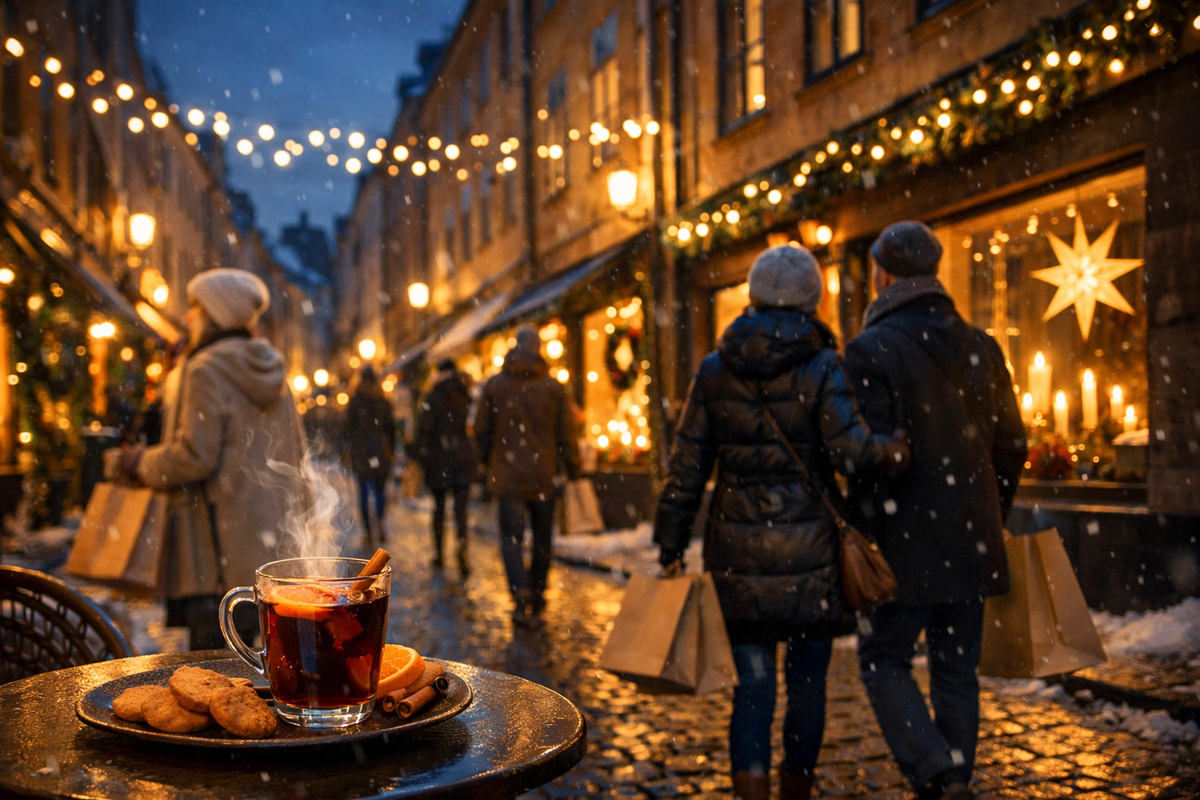
If a shopping mall is about “buy everything at once,” then a walk through small shops in the city center is about Sweden’s atmosphere and character. These are the very streets where warm light glows in the windows, candleholders stand on the sills, and inside you’ll find ceramics, textiles, and things you want to touch with your hands.
In big cities — Stockholm, Gothenburg, Malmö — there are whole streets and neighborhoods where shopping feels more like a stroll through an exhibition: interior studios, small showrooms, local clothing and jewelry brands. In winter it’s especially nice to pop in between walks and cups of coffee.
What you should look for here:
- for home and coziness: décor, tableware, textiles, candles, candleholders, tablecloths, throws, pillowcases;
- for a “beautiful wall”: posters, prints, small paintings, frames, wall decorations;
- for yourself and as gifts: handmade jewelry, bags, scarves, hats, accessories from local brands;
- small décor: Christmas figurines, straw ornaments, little lanterns, holiday hanging decorations.
Pros of this format:
- high uniqueness — it’s hard to find these things in regular chain stores;
- you really feel the “Swedish character”: a mix of simplicity, thoughtful design, and coziness;
- shopping naturally blends into a route through old neighborhoods, markets, and cafés.
Cons exist too:
- prices are often higher than in mass-market stores and supermarkets;
- each shop has a small selection — to compare options, you’ll need to visit several places;
- everything is spread across neighborhoods: you’ll have to wander a bit, sometimes with a map on your phone.
But it’s exactly after streets like these that you get that feeling:
“I didn’t just shop — I visited a Swedish city in winter,” and you take home not only a shopping bag, but a couple of very personal, “your” items that will remind you of the trip every December.
🧴 Supermarkets, chains, and budget shopping
Christmas shopping in Sweden isn’t only malls and design boutiques. A lot of what later looks “Scandi” is quietly sitting on the shelves of regular ICA, Coop, Hemköp and other chain supermarkets — or in “a bit of everything” stores (household goods + décor + sweets).
If your goal is practical and edible gifts without overpaying for a brand name and concept-store vibe, the supermarket is a true must-visit.
What you can buy there for Christmas:
- sweets and cookies:
- jars and boxes of pepparkakor (ginger cookies),
- Christmas candy, caramel, chocolate gift boxes;
- spices and kits for glögg: ready-made mixes, concentrates, syrups;
- ready-made glögg (non-alcoholic and alcoholic — at Systembolaget);
- gift sets: coffee + cookies, tea + sweets, oils, sauces, jams;
- simple but cute decorative bits: candles, candleholders, napkins, festive paper plates and cups, wrapping paper and ribbons.
Pros of this format:
- budget-friendly: you pay for the product, not for the “concept store” atmosphere;
- easy to assemble a “home set” or “edible gifts” for several people at once;
- everything in one place: groceries, sweets, wrapping — you can buy it all in one stop on the way home.
This is an ideal option if you:
- aren’t a fan of brands,
- don’t want to spend time on outlets,
- but dream of coming back with a suitcase that smells of cinnamon, oranges, and Swedish December.
🎄 Shopping vs atmosphere: where “Christmas feels”
Christmas shopping in Sweden can roughly be divided into three formats, and each has its own balance between practicality and “magic”:
- Shopping malls — maximum efficiency: lots of stores, convenient, warm, but the feeling of the country almost disappears;
- Outlets — a bet on brands and discounts: shopping as a mission, and the atmosphere depends a lot on the specific place and the weather;
- Small shops + Christmas markets — the opposite: maximum mood, light, and coziness, but minimum “buy everything at once.”
Below is a mini-table you can use as a quick guide.
| Format | What to go for | Feel and atmosphere |
|---|---|---|
| Shopping malls | Practical purchases, clothing, shoes, electronics, gift sets — everything under one roof. | Convenient and predictable, but the Christmas vibe is more universal than distinctly “Swedish.” |
| Outlets | Discounted brands, bigger purchases, wardrobe updates, and sports/outdoor gear. | The atmosphere depends on the place: sometimes it feels like an open-air mall, sometimes — just a “shopping village.” |
| Small shops + markets | Unique décor, Scandi design, edible gifts, characterful items — not about “mass shopping.” | Maximum Christmas “magic”: lights, window displays, the smell of glögg and baked goods, and a true winter fairytale feeling. |
If you want to fill a suitcase, it’s best to rely on shopping malls and outlets, adding just a bit of atmosphere on top.
If you want to fall in love with Swedish winter, you can leave malls for a couple of hours and spend most of your time in small shops and markets.
⏰ Opening hours, red days, and the pre-Christmas rush
In December, Swedish shopping follows its own rules. On the one hand, before Christmas many malls and stores extend their opening hours: they may open earlier than usual and close later, especially on weekdays 1–2 weeks before Julafton. On the other hand, there are days when everything suddenly “shrinks” in the opposite direction.
It’s important to remember the red days (public holidays) and “semi-holiday” dates:
- official days off — December 25 and 26, January 1, January 6;
- December 24 and 31 are not always official red days, but many shops, offices, and malls operate on very reduced hours and close around midday / in the afternoon.
As a result, the rhythm looks like this:
- a week before Christmas — peak rush, extended hours, lots of people;
- December 24–26 — a sharp slowdown, quiet streets, short day or everything closed;
- after New Year’s — a calmer mode and sales, but still with adjustments for red days.
That’s why in December and early January it’s critical to check opening hours for the exact dates:
- for malls and outlets — on their official websites;
- for small shops — in Google Maps, social media, or on the door (they often hang a separate notice with Christmas hours).
This ties in nicely with the broader theme of the winter calendar and red days: the same rule works for shopping, for visiting government offices, and for planning trips between cities. The more careful you are with dates, the lower the chance you’ll end up in front of a beautiful window display… with a closed door and a sign: “Today we close early, God Jul!”
💸 Budget: what’s pricier, what’s more cost-effective
During the Christmas season in Sweden, you can spend a lot — or quite reasonably. It all depends on where you go and what your goal is.
If we simplify the picture a lot, it turns into a ladder like this:
Small shops and design studios
- Most often, this is the most expensive format.
- You pay for design, ideas, small batches, and local brands.
- In return, you get characterful items that are hard to find elsewhere.
Shopping malls
- The mid-range: familiar clothing, shoes, beauty, and electronics brands.
- You can catch discounts, but overall the price level is roughly what you’d expect from Scandinavia.
Outlets
- Potentially the best value for branded items.
- But there’s a “hidden cost”: travel, a whole day of time, food there, and sometimes a rental car.
To keep Christmas shopping from turning into a financial marathon, a few simple rules really help.
How not to go broke on Christmas shopping
Decide in advance what you’re buying
Not “we’ll see there,” but at least in broad strokes:
- gifts (for whom and roughly what budget);
- clothes/shoes (which specific items, not just “whatever I like”);
- home items (textiles, décor, tableware — or just a couple of small things).
Separate “pretty” from “I’ll actually use it”
On small streets and in design shops, almost everything looks incredibly beautiful. A good filter is:
- imagine this item in your home in a month and in a year;
- if you clearly see where it will stand/lie/hang and how you’ll use it — it’s a candidate;
- if the feeling is “I don’t know, but it’s so cute” — chances are it’s a future dust collector.
Set a rough limit for “emotional purchases”
For example: two or three items “just because I want them” — and that’s it. This helps you avoid packing half the window display into your suitcase.
Remember supermarkets
Some gifts (especially edible ones) can absolutely be put together in chain stores — it will be cheaper, and they can look just as good as in small boutiques.
That’s how Christmas shopping in Sweden becomes not a test for your bank card, but a thoughtful collection of things that will actually live with you — and every winter will remind you of the trip, not of the bank statement.
👨👩👧 Shopping with kids: mall, outlet, or city center?
Almost any shopping trip with kids is no longer just “running errands,” but a small expedition. In pre-Christmas Sweden it’s especially noticeable: lights, crowds, music, lots of stimulation everywhere. So it’s important to choose a format that fits your family — not one that’s simply “the done thing.”
Shopping malls: maximum convenience and predictability
With kids, malls are usually the easiest option:
- inside, the weather doesn’t matter — rain, wet snow, and wind won’t get in the way;
- there are almost always toilets, changing rooms, elevators, and escalators;
- cafés and food courts let you take breaks for food, hot chocolate, or dessert;
- sometimes there are kids’ play areas where a child can “burn off energy.”
There’s one downside: the atmosphere is less Christmassy and less “Swedish.” But if the goal is not to freeze and to calmly buy gifts, malls often win.
Outlets: lots of walking and unpredictable weather
Outlets with kids are a tougher story:
- lots of walking outdoors between pavilions;
- in winter there can be wind, snow, slush — kids get cold and tired quickly;
- the trip there and back is already noticeably exhausting.
It makes sense to take kids to an outlet only if:
- you have a very specific goal (for example, buying winter clothing for everyone at once);
- your child is old enough and handles long walks well;
- you’re ready to make shopping the only big thing you do that day.
City center: a balance of walking and shopping
A stroll in the center with small shops and markets can be a great compromise:
- you can alternate between shops, cafés, parks, and markets;
- kids enjoy the lights, Christmas decorations, and street food;
- there’s always a chance to turn it into a mini-adventure: carousels, a hot drink, window-gazing.
But remember: it’s still outdoors in winter. You’ll need good clothing, some patience, and the readiness to “duck into” a café or head back to the hotel at any moment.
To keep shopping from becoming a nightmare: mini tips
- Plan time in short blocks, not “six hours of shopping.”
- Make shopping part of a walk — not the only goal of the day.
- Always have a “warm spots map”: cafés, food courts, places to sit and warm up.
- Plan clothes and shoes as if you’re going on a winter walk, not to a mall “for just an hour.”
- Bring a snack and water so you don’t end up with a checkout meltdown.
Then Christmas shopping in Sweden will be associated for your child not with long lines, but with lights, sweets, and the feeling of a small family adventure.
✈️ How to fit shopping into a Christmas trip
Christmas shopping in Sweden is much nicer when it doesn’t “eat” the entire trip, but fits neatly into the route. The logic is simple: first impressions, then shopping bags 😉
Model 1: one evening in a mall + one evening downtown/at a market
A convenient option for a short trip:
- one day you explore the city, and in the evening you pop into a mall to buy practical gifts, clothes, electronics, cosmetics;
- another day you bet on the center and the market: small shops, design boutiques, souvenirs, atmosphere.
This way you cover the “useful” purchases and still have time to feel Swedish Christmas in its natural setting — on streets and squares.
Model 2: a dedicated outlet day + a “pure” city day
If you truly want an outlet, it’s better to honestly give it a full day:
- morning: travel there;
- daytime: stores, fitting rooms, lunch on site;
- evening: return and rest.
And plan the next day as completely “no shopping”: walks, museums, parks, markets, cafés. Then you won’t feel like the entire trip turned into a shopping run.
Model 3: shopping at the end of the trip
Another workable scenario:
- first days — only the city, atmosphere, markets, walks; at most you “scout” what you like;
- last day or half-day — dedicated to shopping: mall, supermarket, a couple of targeted shops.
Pros:
- you don’t have to carry bags for the whole week;
- by the end of the trip you already know what you’re missing: gifts, sweets, décor, or warm clothes.
The main idea is to treat shopping as one element of a winter route, not the only goal (unless, of course, you’re flying specifically “for brands”). Then Christmas Sweden will be remembered not only for price tags, but also for lights, the smell of glögg, and the feeling of a very cozy winter.
❓ FAQ about Christmas shopping in Sweden
- Does it make sense to fly to Sweden specifically for Christmas shopping, or is it better just “along the way”?
If you love winter, lights, and a cozy city vibe — yes, it makes sense. Shopping fits well on top of the main program: you walk during the day, and in the evening you drop into a mall, small shops, or a supermarket for gifts. Flying only for an outlet is debatable, but combining atmosphere and shopping is very pleasant.
- Where is it better value to buy gifts: malls, outlets, or small shops?
- Malls are the golden middle: familiar brands, mid-level prices, convenience.
- Outlets are a chance to save on brands if you need a bigger shopping day.
- Small shops are pricier, but more unique.
If your budget is limited, a good mix is: supermarket + a bit of mall, and one or two special items from small shops.
- Are supermarkets even good for gifts?
Yes — very much so. You can put together:- glögg and spices for it,
- cookies, sweets, coffee, tea,
- simple candles, napkins, wrapping.
This is perfect for “edible gifts” and small surprises for colleagues and friends.
Is it worth spending a day on an outlet if I only have 3–4 days in Sweden?
Only if you have a clear shopping plan (“I need a jacket, shoes, sportswear”) and you’re truly ready to dedicate a full day to it. If the main goal is Christmas atmosphere and the city, it’s better to invest time in markets, the old town, and small shops.
Can I do only the city center and small shops without malls and outlets?
Yes, if:
But then it makes sense to add a supermarket stop to pick up edible and budget gifts.
What day is better for shopping: weekdays or weekends?
What is better to buy specifically in Sweden rather than at home?
Most often it makes sense to look at:
Do I need Tax Free, and is it worth the hassle?
If you’re making big purchases (clothes, shoes, electronics), Tax Free can give noticeable savings — it’s worth checking the conditions in specific stores and malls. If shopping is limited to sweets, décor, and small items, doing Tax Free usually doesn’t repay the effort.
How do I avoid turning shopping into chaos and spending three times more than planned?
A simple set of rules helps:
What if I don’t like shopping, but gifts are still needed?
Do one fast, straightforward run:
- stop by a supermarket for edible gifts and simple sets;
- choose one or two items in a small shop for your closest people;
- buy the rest online once you’re back home.
That way you spend minimal time in stores and maximum time on streets, markets, and cafés — and still end up with gifts that have a “Swedish accent,” without extra stress.
🔚 How to make shopping pleasant, not exhausting
In Christmas-time Sweden, it’s easy to fall into the temptation to “do it all”: malls, outlets, markets, small boutiques. But in the end, what matters is not ticking off the maximum number of places — it’s understanding the formats and your goals: where you buy practical things, where you pick up unique small items, and where you simply walk for the atmosphere. Then shopping stops being a marathon and becomes part of a winter trip.
The approach that works best:
- combine formats: take a little from malls, markets, and small shops instead of obsessing over one;
- decide a budget and a list in advance — at least roughly who and what you’re looking for, so you don’t grab everything;
- treat shopping as another way to feel Swedish winter — with lights, the smell of glögg, textiles, candles, and home ideas — not as a race with bags and tired feet.
If you want to plan the route more deeply, you can lean on other materials in the series: about Christmas markets, Advent, Saint Lucia Day, Christmas in different regions, and what winter is like in Sweden from the south to Lapland. Together, they help build a complete picture — of the holidays, the shopping, and the mood.

0 comments
Log in to leave a comment