



🌗 Polar day and polar night in Sweden: when to go to Lapland and what to take
🌍 Polar Day and Polar Night: What They Are and Why Sweden Has Them
After the heading: Polar Day and Polar Night aren’t “astronomy for scientists” — they’re real, plan-able travel experiences in Sweden. In Swedish Lapland, light and time behave differently, and it changes the whole feeling of a trip. Some travelers come for an endless summer, when you can hike at midnight in daylight. Others come for winter silence and skies that sometimes ignite with the Northern Lights. The key is understanding the basics so you can choose the right season and get the best version of the Arctic.

✨ A simple explanation of “24 hours of light” and “the sun doesn’t rise”
Polar Day (the Midnight Sun) is the period when the sun doesn’t dip below the horizon in northern Sweden, so it can be bright even at midnight. This isn’t just “white nights” like farther south — it’s the feeling that night has been switched off. For travelers, it means more freedom: you plan around your energy, not around darkness.
Polar Night is the opposite, when the sun doesn’t rise above the horizon and daytime looks like prolonged twilight. It’s important to know this isn’t always pitch-black; often you still get a soft blue glow and a beautiful “blue hour.” In this season, Swedish Lapland feels especially cinematic and atmospheric.
This happens because of Earth’s tilt and latitude — in practice, geography is everything. The farther north you go, the stronger the effect. So the simplest planning rule is: look for places in Sweden above the Arctic Circle. That’s where “Midnight Sun” and “Polar Night” stop being words and become something you live.
🧭 Where to See Polar Day/Night in Sweden
After the heading: Open a map and it becomes obvious: the real magic starts in the far north, near and above the Arctic Circle. That’s where Polar Day and Polar Night are not metaphors — they’re daily reality. For a first Scandinavian trip, it’s smart to pick places that are easy to reach and have solid accommodation and tours. In Sweden, that usually means choosing a reliable base in Swedish Lapland. From there, you tailor the route to your priorities: nature, photography, or winter adventures.
🗺️ Swedish Lapland and the best first-timer bases
If this is your first trip to Scandinavia, Swedish Lapland is the region to remember. You get wide-open landscapes, clean air, lakes, forests, and mountain valleys — the “real North” feeling. You also get practical infrastructure because people travel here specifically for Arctic experiences.
The most popular bases are Kiruna and Abisko. Kiruna feels like a northern hub: convenient services, transport connections, and easy access to tours. Abisko is closer to dramatic nature and those postcard-worthy scenes you want to keep in your head forever.
Other options include Jokkmokk and Gällivare if you prefer fewer crowds and a calmer rhythm. A simple tip: choose your location based on your main goal — nature and photos, or convenience and quick day trips. That way your trip feels intentional, not random.
🧭 Fast location pick
Kiruna — best if you want an easy base, transport, and tours nearby.
Abisko — best if you’re coming for nature, trails, and big views.
Jokkmokk / Gällivare — best if you want quiet “Nordic calm” and fewer people.
📅 When to Go: Best Months and How to Choose Your Season
After the heading: The most common question is “what dates does this happen?”, and you don’t need to overthink it. Polar phenomena come in seasonal windows, and the exact intensity depends on how far north you are. Travelers don’t need astronomy — you just need the right month and the right town. Then you decide what kind of trip you want: endless daylight or deep Arctic twilight. Once that’s clear, everything else (activities, packing, and daily rhythm) becomes easy.
🧩 Polar Day vs Polar Night — which one fits you?
In northern Sweden, Polar Day typically sits around late May through mid-July, with the strongest effect near the summer solstice. It feels like endless summer because you’re not racing against darkness. For active travelers, it’s a dream: more freedom and more hours for experiences.
Polar Night is most associated with December and early January, when the sun doesn’t rise and the day looks like extended twilight. This is the season of cozy hotels, saunas, winter activities, and the classic “Northern Lights hunt.” If you want atmosphere, quiet, and winter magic, this is your lane.
To pick your ideal month, decide what matters more: summer hikes and lightness, or winter depth and aurora chances. A simple first-timer rule works well: choose Polar Day for maximum movement and outdoors, choose Polar Night for maximum contrast and emotion. Either way, the Swedish North will surprise you.
🌞 Polar Day: What to Do in the Arctic Summer
After the heading: Polar Day is when you realize “evening” can last for hours. Your planning logic changes: you check the clock less and feel less rushed. It’s the perfect time for trails, lakes, and viewpoints without worrying about darkness. Summer Lapland feels airy, open, and unbelievably fresh. And the soft light makes even simple photos look like a poster.
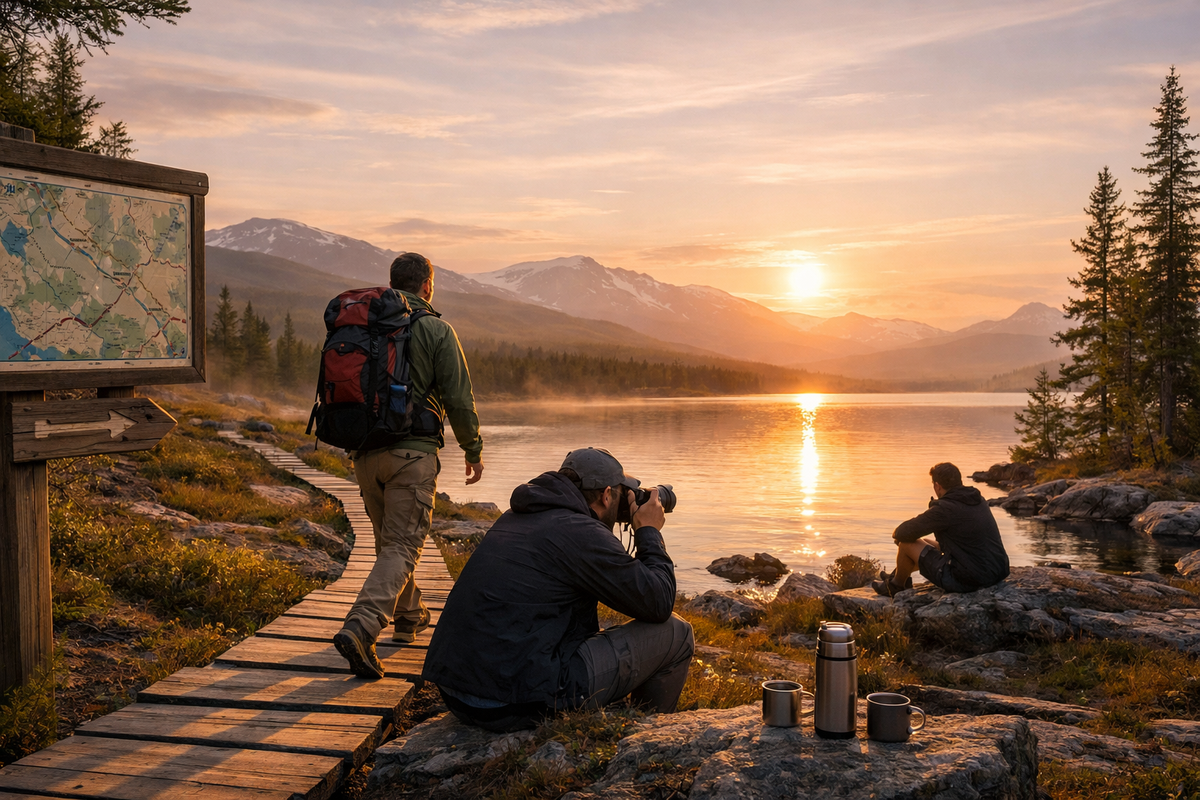
🥾 Trails, lakes, and the freedom of daylight
Polar Day isn’t just “wow, it’s bright” — it’s incredibly practical. You can shape the day around your energy: start early, hike longer, pause by a lake, and return without panic. Suddenly you have a “time buffer” that usually doesn’t exist in the mountains.
In summer, Swedish Lapland is great for hiking, nature watching, and scenic drives to panoramic spots. Even a simple evening walk becomes a highlight because the light stays gentle and photogenic. It’s a season when you do more — not because you must, but because you want to.
For photos and video, Polar Day gives you something rare: long stretches of flattering light and calm frames without harsh shadows. Timelapses, wide landscapes, and water reflections work beautifully. You’ll also understand why people say the Arctic is “a place where the air looks different.”
🌚 Polar Night: Winter Lapland and Your Chance to See the Northern Lights
After the heading: Polar Night can sound intimidating, but in reality it’s one of the most atmospheric seasons in the Arctic. Daylight becomes rare and precious, and every warm interior feels extra cozy. You travel slower, but deeper — as if you’re actually living each detail. Many people choose this season for a real reset and quiet northern mood. And if the sky cooperates, you’ll see the aurora exactly the way you’ve imagined it.
🌌 Aurora Borealis, snow adventures, and Arctic atmosphere
Polar Night is when northern Sweden feels most “otherworldly.” The light is short and soft, and the rest is gentle darkness where streetlights look like stage design. It’s a season for travelers who want the North as a feeling, not just a checklist.
The main reason to come in winter is the Northern Lights, because dark skies give you more opportunity to see them. The aurora isn’t scheduled, but you can boost your odds: get away from city lights and watch the cloud cover. Several nights in a row usually beat a single “all-in” attempt.
Beyond aurora chasing, winter is for dog sleds, snowshoe walks, snowy landscapes, and sauna evenings. Even dinner after a cold day feels special because you’re truly inside the Arctic experience. And yes — it’s the kind of trip you return from thinking, “I’ve seen another planet.”
🌌 Aurora tip: plan 3–5 nights in the North so you can “wait out” clouds.
🏙️ Even more important: leave the city lights behind — they reduce visibility a lot.
🧤 And the obvious: dress warm — the best sky isn’t fun if you’re freezing.
🧳 Practical Tips for Your First Trip to Scandinavia
After the heading: The best part about Sweden is that “hard” becomes easy if you know a few simple rules. In the Arctic, sleep, clothing, and your attitude to weather matter more than fancy gadgets. Good preparation doesn’t make a trip boring — it makes it free. You spend less time solving discomfort and more time enjoying the landscape. And you’ll feel confident even in a new northern environment.
✅ Sleep, layering, tech, and comfort (no surprises)
The biggest surprise during Polar Day is sleep, because your brain doesn’t always accept that “it’s bedtime.” A sleep mask and a dark room solve it better than any complicated method. A simple routine helps too: lower screen brightness in the last hour and keep your indoor light warm and calm.
Clothing in the North works by layering, and it matters more than brands or fashion. You want control over wind and moisture, not just a “thick jacket.” Even in summer, evenings can be chilly, and in winter, smart layers decide whether a walk feels joyful or exhausting.
Tech is its own story, especially in winter: cold drains batteries faster, and your phone can give up before you do. A power bank and keeping devices close to your body help a lot. If you plan night photos, set up your camera in advance so you’re not relying on luck.
✅ A Simple 3–5 Day Plan: Two Ready-Made Scenarios
After the heading: If you don’t want to invent your itinerary on the spot, it helps to have two simple templates — one for summer and one for winter. This way you start strong and don’t lose days to indecision. Northern Sweden loves a calmer pace, but that doesn’t mean it’s boring. You often see more when you’re not constantly moving bases. That’s why one base with several day trips is the best first-timer format.
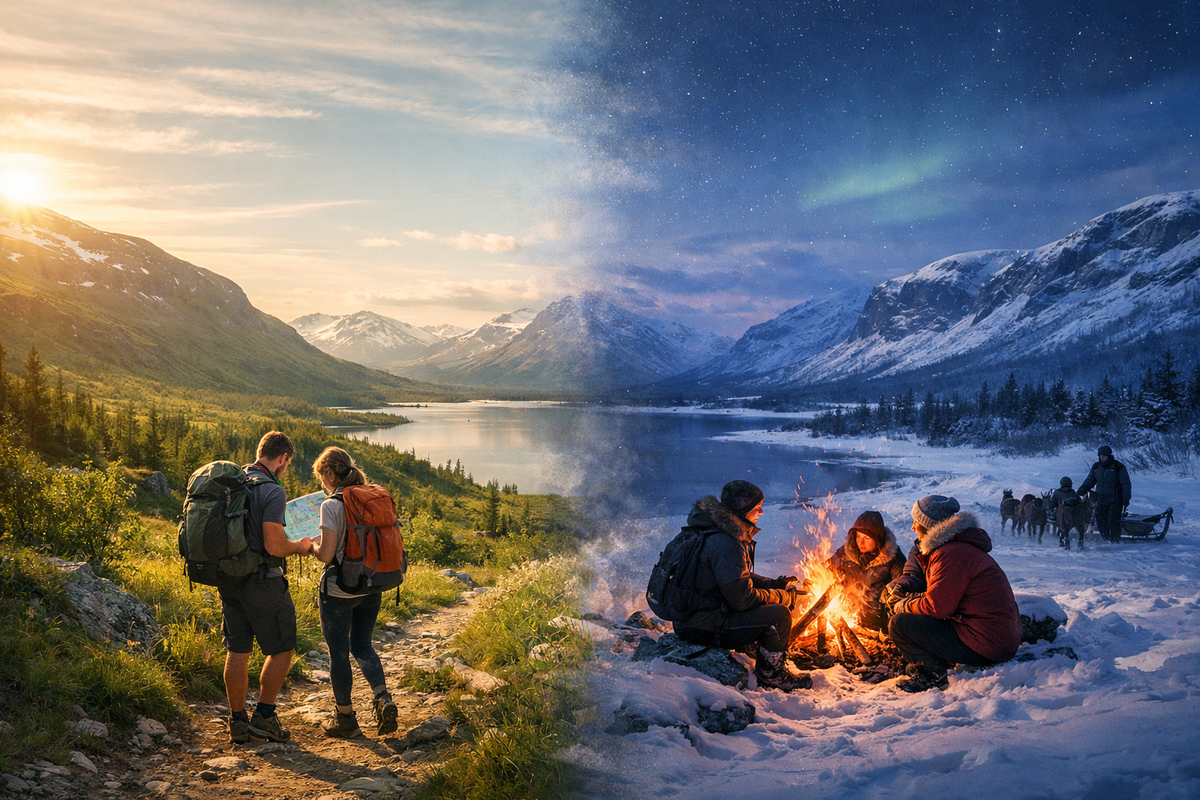
🗓️ Summer vs winter — easy ideas you can use immediately
In summer Polar Day, the “one base, many day trips” format works perfectly. You do trails and lakes during the day, then viewpoints and slow walks in soft light in the evening. At some point you realize you’re tired not from darkness — but from experiences.
In winter Polar Night, the rhythm changes: daytime for activities and scenery, evening for aurora attempts. It’s worth planning so you still have energy for a night outing, because that’s often the highlight. Here, fewer “checkboxes” and more quality time usually wins.
Your base choice is mostly about convenience: if you want everything close, choose Kiruna; if you want nature at your doorstep, choose Abisko. Both work for 3–5 days — they just create different moods. The key is not trying to “do the entire North” in one trip.
✨ What You’ll Bring Home from Sweden (Besides Photos)
After the heading: After a journey to northern Sweden, many people return with a strange feeling — as if time worked differently there. You’ll remember not only views, but also light, silence, air, and space. Polar Day gives lightness and freedom, Polar Night gives depth and emotion. Both seasons suit first-timers if you pick the right trip format. And it’s the kind of route you want to repeat in the other season, just to see the Arctic’s “second version.”
💙 Why Polar Day and Polar Night stay with you
Polar Day gives a feeling of freedom, like time stretches and you can live more than usual. You return thinking you can walk “as you want,” not “as you must.” It’s a perfect season for movement, nature, and a light, happy mood.
Polar Night, on the other hand, brings a sense of depth and calm that everyday life often lacks. The North makes simple things meaningful: tea after cold air, a warm window, a dark sky above you. And if the aurora appears, it becomes one of the strongest travel emotions you can have.
Sweden is special because summer and winter offer different kinds of the same magic. You just choose what calls you: endless light or endless sky. Either way, you’ll understand why a first trip to Scandinavia often becomes a habit.
Questions and Answers (FAQ)
In Swedish Lapland, above the Arctic Circle, with Kiruna and Abisko being the most common bases. They’re easy to use for tours and day trips. That makes them a great first-time choice.
A good rule of thumb is late May through June–July, with stronger effects the farther north you go. During this time, daylight can last all night. It’s the best season for active summer travel.
A good rule of thumb is December and early January, when the sun doesn’t rise above the horizon. The day looks like long twilight and the night becomes the main stage. It’s peak season for winter mood and contrast.
Usually not, because you often still get twilight and a soft “blue hour,” especially during daytime. There’s simply very little direct sunlight. The feeling is still unusual and memorable.
Not really — it’s too bright. For aurora, people typically go in autumn and winter, including the Polar Night period. Darkness is your best friend.
Use a sleep mask or blackout curtains, and build a calm evening light routine. Reduce screen brightness before bed. Your body will adapt faster than you expect.
Layered clothing, wind protection, warm boots, gloves, and a hat. This matters more than one “super warm” jacket. Ice grips and a thermos are also very helpful.
Plan 3–5 nights, leave city lights behind, and watch the cloud cover. Don’t quit after the first try. Aurora rewards patience.
3–5 days is ideal: enough for activities and multiple weather/aurora attempts. One base with day trips usually works best. It keeps the trip calm and rich.

0 comments
Log in to leave a comment