

💸 Prices in Sweden, Norway, Denmark and Finland: where is it most expensive and how to plan your budget by country
💶 ‘Expensive, but real’ — myths about prices in Scandinavia
There is a common myth about Scandinavia: prices in Scandinavia are ‘astronomical,’ and travelling there is only for those who don't care about money. Because of this, many people don't even start planning their itinerary and answer the question ‘Is it expensive to travel in Scandinavia?’ with ‘yes, too expensive.’

In reality, it's not that dramatic. If you understand how accommodation, food and transport costs work in Sweden, Norway, Denmark and Finland, it's quite possible to keep your budget for a trip to Scandinavia under control. In this article, we'll look at where it's most expensive and how much money it's reasonable to budget per day for each country.
“Scandinavia isn’t for budget travelers at all”.
Reality. With early booking, choosing the right season, and focusing on nature, not only restaurants, a trip can cost about the same as popular routes in Western Europe.
“Prices are equally high everywhere”.
Reality. Norway and Denmark are usually more expensive than Sweden and Finland, and capitals are noticeably more expensive than smaller towns — and you can use this when planning your route and budget.
If you want to dive straight into the details for specific countries, check out our travel guides with planning and budget tips:
— Norway: routes, fjords and real costs
— Denmark: Copenhagen, cities and coastlines
— Finland: Helsinki, Lapland and the islands
💸 Where is it most expensive: a comparison of prices in Sweden, Norway, Denmark and Finland
Scandinavia almost always appears on lists of the most expensive regions in Europe, and where is the most expensive place in Scandinavia is one of the first questions travellers ask themselves. In general, prices in Norway, Denmark, Sweden and Finland are higher than in most European countries, but the level of ‘wallet pain’ varies significantly from country to country.

It is important to distinguish between the cost of living and prices for tourists. For locals, taxes, salaries and rent play a major role, while for travellers, it is primarily the cost of hotels, restaurants, transport and entertainment. Therefore, even if the overall cost of living is high, tourists can partially control their budget by choosing their accommodation, food and itinerary.
📊 Cost of living rating for tourists
A rough affordability ranking for travelers
Below is a general guide to how prices feel in Norway, Denmark, Sweden, and Finland from a tourist’s point of view: accommodation, restaurants, transport, and basic trip expenses.
Norway
The most noticeable country price-wise: expensive accommodation, restaurants, and especially alcohol. Fjord regions and the north often push the budget even higher.
Denmark
Copenhagen is one of Scandinavia’s most expensive cities for restaurants and hotels. Outside the capital prices in Denmark feel softer, but still above the European average.
Finland
In a regular season prices in Finland are a bit lower than in Norway and Denmark. But Helsinki and especially winter Lapland can noticeably raise the daily budget.
Sweden
Prices in Sweden are still high, but often slightly lower than in Norway and Denmark. Outside Stockholm, accommodation and food feel more affordable, especially if you choose apartments and supermarkets.
🏙️🌲 Capitals vs regions and the north
If you look at the prices in Norway, Denmark, Sweden, and Finland on a map, a simple pattern immediately becomes apparent: the most expensive places are Oslo, Copenhagen, Stockholm, and Helsinki. Housing, restaurants, and entertainment are more expensive here because demand from tourists and locals is very high, while supply is limited. Even within the same country, the difference between the capital and a small town can easily add or subtract 20-30% to your daily budget.
The northern regions are a different story: Lapland, northern Norway and northern Sweden. Here, prices are influenced by logistics (delivery of goods, a small number of hotels and cafes), strong seasonality and the popularity of winter activities such as the Northern Lights and Christmas tours. As a result, during the high season, the north can feel more expensive than the capital, especially in terms of accommodation and excursions.
Understanding these differences helps you plan your itinerary flexibly: you can spend fewer days in the most budget-friendly locations and add more stops in small towns or natural regions — this will make your budget for travelling in Scandinavia significantly more comfortable without losing any of the experience.
💰 How much money to budget per day: sample budgets by country
Planning a trip to Scandinavia is much easier if you think not only about the total cost of the trip, but also about your daily budget in each country. This makes it easier to estimate how many nights you can spend in the capitals, how many in smaller towns, and how many days to spend in the countryside.
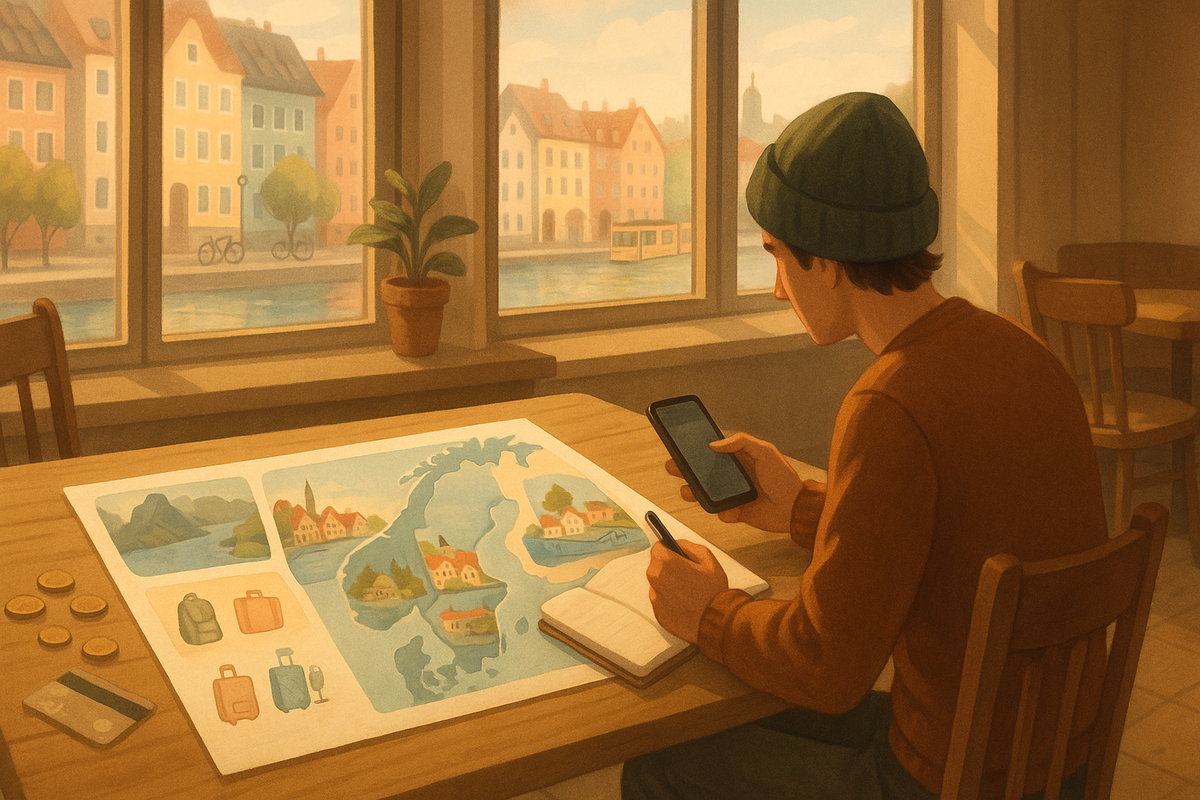
At the same time, it is important to understand that even within the same region, there are noticeable differences. The daily budget in Sweden is usually slightly lower than in Norway or Denmark, while Finland depends heavily on the season and whether you are travelling to Lapland. Below is a general guide to help you get a feel for the costs in each country and for each travel style: budget, average and comfortable.
Sample daily budget by country
These are not strict numbers, but spending-style guidelines: what a day might look like for a budget, mid-range, and comfortable traveler in Sweden, Norway, Denmark, and Finland.
Sweden
The golden middle of Scandinavia: still expensive, but softer than its neighbors with smart planning.
A hostel or budget apartments, meals from supermarkets and inexpensive cafés, walking and local public transport. This format helps keep a daily budget in Sweden under control even in Stockholm.
2–3* hotels, lunches in cafés, a good restaurant once or twice during the trip, 1–2 paid tours or a museum per day. A balance between comfort and sensible spending.
3–4* hotels, restaurants, convenient intercity trains, extra activities — archipelago cruises, themed tours, and so on.
Norway
The most wallet-demanding country: fjords, transport, and excursions quickly increase costs.
Hostels or campsites, cooking in shared kitchens, traveling by buses and trains with early booking. This can significantly reduce how much money to take to Norway.
Simple hotels or apartments, cafés and inexpensive restaurants, 1–2 organized excursions (for example, a fjord cruise) across a few days of the trip.
Cozy hotels, panoramic railways, several paid tours, restaurant dinners, and a freer approach to choosing activities.
Denmark
Expensive primarily in Copenhagen; in other cities the travel budget in Denmark feels milder.
A hostel or a hotel outside the center, street food and supermarkets, renting a bike instead of constantly using the metro. A good way to feel Copenhagen without a wallet shock.
A 2–3* hotel in a convenient neighborhood, a mix of cafés, street-food markets, and restaurants, Copenhagen Card or similar passes to combine transport and museums.
Central hotels, chef-driven cuisine, several paid museums and attractions, train trips around the country without a strict focus on promo fares.
Finland
How expensive Finland feels for a tourist depends greatly on the season and whether Lapland is in your route.
Hostels or simple hotels, affordable lunches, supermarkets, local transport, and free or low-cost activities like walks and city saunas.
Comfortable hotels in Helsinki or other cities, restaurants paired with cafés, ferry trips through the archipelago or to neighboring countries, 1–2 excursions.
Cozy chalets or cottages in Lapland, winter activities, safaris, spa, and a freer choice of restaurants and transport options based on convenience rather than price.
🌲 Sweden: daily budget in Stockholm and the regions
In Sweden, the difference between the capital and other cities is particularly noticeable. The daily budget in Sweden is higher in Stockholm due to hotels and restaurants, but in neighbouring cities and on the coast, accommodation and food become significantly more affordable. The good news is that even in the capital, you can save a lot by choosing apartments and actively using supermarkets and ready-made lunches.
Sweden often turns out to be the ‘golden mean’ of Scandinavia: here it is easy to combine nature and cities, travel by train and ferry, without going beyond a reasonable budget. For many travellers, it makes sense to build a route around Sweden, adding short trips to Norway, Denmark or Finland.
🌊 Norway: how much does a trip to the fjords cost
Norway is almost always the country where you need to budget the most money. How much money to take to Norway depends primarily on how actively you want to travel around the fjords and northern regions. Panoramic railways, ferries, fjord cruises and winter activities quickly increase your daily budget, especially if you book everything at the last minute.
You can reduce your expenses by choosing apartments with kitchens, booking trains and buses in advance, choosing your route wisely (fewer chaotic transfers, more days in one place) and making informed choices about excursions.
🕯️ Denmark: budget for a trip to Copenhagen and beyond
The budget for a trip to Denmark is largely determined by Copenhagen, which is one of the most expensive capitals in the region in terms of hotels, restaurants and bars. This is where daily expenses can easily skyrocket if you live in the centre and eat only in restaurants. If you move a little further away from the capital or choose a less touristy area, the cost of accommodation drops significantly and your overall budget becomes more manageable.
You can save money by staying outside the city centre, actively using bicycles, visiting street food markets and food courts instead of restaurants, and using city cards such as the Copenhagen Card, which combine transport and visits to the main attractions.
❄️ Finland: Helsinki, the archipelago and Lapland
The cost of visiting Finland for tourists depends greatly on the season. In summer and during the off-season, the daily budget in Helsinki and coastal cities is moderate by Scandinavian standards: comfortable hotels, reasonable prices for cafés and city entertainment. But as soon as you add Christmas Lapland, husky safaris and northern lights hunting to your itinerary, the cost of accommodation and activities increases significantly.
Finns and experienced travellers often combine their trips: they use ferries to Tallinn or Stockholm, choose a reasonable balance between restaurants and supermarkets, and include inexpensive but atmospheric activities in their itinerary, such as city saunas, walks around the archipelago and local markets.
🧾 What costs the most money in Scandinavia
Even if the routes and styles of travel vary greatly, the overall cost structure is similar: accommodation in Scandinavia, food, transport and entertainment. Most often, it is the combination of hotels/apartments and restaurants that makes a trip ‘expensive’, and a competent approach to these four points allows you to comfortably stay within a reasonable budget.

Where most of your money goes in Scandinavia
Regardless of your route, a travel budget in Sweden, Norway, Denmark, and Finland is usually built around four key categories: accommodation, food, transport, and activities.
Accommodation
from hostels to campsites
Accommodation in Scandinavia is the biggest expense, especially in the capitals and fjord regions. Hostels, campsites, and cabin rentals can noticeably reduce your daily budget compared to classic hotels.
Food
restaurants vs supermarkets
Restaurant food prices in Sweden and Norway can quickly “eat up” your budget. Shopping at supermarkets, bakeries, and lunch menus lets you eat well for significantly less.
Transport
trains, buses, ferries
Convenient transport between the Scandinavian countries — trains, buses, and ferries — makes it easy to cover several countries in one route. Early booking and overnight services help you save both time and money.
Activities and experiences
museums, nature trips, city passes
How much activities cost in Scandinavia depends on your choices: from free parks and trails to pricey tours and ski passes. City cards like Stockholm Pass and Copenhagen Card can significantly optimize your expenses.
🏨 Accommodation: from hostels to campsites
Accommodation in Scandinavia is almost always the main expense. Hotels in Oslo, Copenhagen, Stockholm and Helsinki are more expensive than in many other European capitals, especially during the high season and on days when major events are taking place. Prices also rise in the fjord regions of Norway and in Lapland during the winter due to limited availability and very high demand.
Several strategies can help reduce costs:
– choosing hostels and budget hotels;
– booking apartments with kitchens, which makes it easier to control food costs;
– camping and renting cabins (hytte, stuga) in Norway and Sweden, where you can live closer to nature and save significantly;
– booking early, especially for the summer and Christmas period.
Many regions of Sweden and Norway operate on the principle of ‘allemansrätten’ and have a developed camping culture, which allows you to plan your trip beyond city hotels.
🍽️ Food: restaurants vs supermarkets and street food
If you don't think about the format of your meals, food prices in Sweden and Norway can come as an unpleasant surprise: dinner at a restaurant can easily eat up a significant portion of your daily budget, especially if you add alcohol to the bill. Denmark and Finland are not far behind in terms of restaurant prices.
However, Scandinavia has a big advantage — excellent supermarkets, bakeries and inexpensive lunch menus. In all countries in the region:
– supermarkets offer ready-made salads, sandwiches and hot dishes that you can take with you;
– business lunches are significantly cheaper than dinners;
– street food and street food markets (especially in Copenhagen and Stockholm) allow you to try local cuisine without paying ‘restaurant’ prices.
A comfortable strategy for most travellers is to combine: buy breakfast and some dinners at the supermarket or in your apartment, and set aside a budget for good restaurants for lunches and a couple of evenings during your trip.
🚆 Transport: trains, buses, ferries between countries
Transport between the Scandinavian countries is well organised: trains, buses and ferries make it easy to plan combined routes, such as Stockholm–Oslo–Bergen or Stockholm–Copenhagen–Malmö.
Popular connections:
– Trains and buses between Sweden and Norway (Stockholm–Oslo, Gothenburg–Oslo);
– Trains and buses between Sweden and Denmark (via the Øresund Bridge: Stockholm/Gothenburg–Copenhagen);
– ferries Stockholm–Helsinki, as well as flights to Tallinn and other Baltic ports.
Main ways to save money:
– buy tickets in advance on national railway websites and from trusted bus operators;
– look for night trains: this is both a journey and a night's hotel stay saved;
– use night ferries between capitals – essentially a mini-cruise with a cabin, which also works as ‘transport + accommodation’.
Within cities, it is advantageous to use travel cards and city cards that include transport: this is particularly noticeable in Stockholm, Copenhagen and Helsinki.
🎟️ Entertainment and activities: museums, nature trips, city passes
When talking about how much entertainment costs in Scandinavia, it is important to distinguish between two types of activities:
– urban: museums, observation decks, amusement parks, themed tours;
– natural: hiking, national parks, fjords, islands, winter activities.
Most natural locations are formally free or very inexpensive (parking, camping, ferry fees). The biggest expenses are for organised tours: fjord cruises in Norway, winter safaris in Finland, seasonal activities in the northern regions.
City pass cards are very useful for urban entertainment:
– Stockholm Pass and other card options for Stockholm;
– Copenhagen Card;
– city cards for Helsinki and Oslo.
They combine transport and admission to major museums and attractions and are especially beneficial if you enjoy a busy schedule: 2-3 museums a day + active travel around the city. If you prefer to just stroll through the streets and parks, a city pass may not be necessary — Scandinavia has plenty of free beauty and attractions outside of paid locations.
🗺️ How to plan your route and budget by country
A well-planned itinerary for Scandinavia not only helps you see as much as possible, but also understand how to plan your budget for each country so that your trip does not turn into a spending marathon. Sweden is a logical place to start: it has good air connections, convenient ferry and rail links, and tourist-friendly infrastructure.
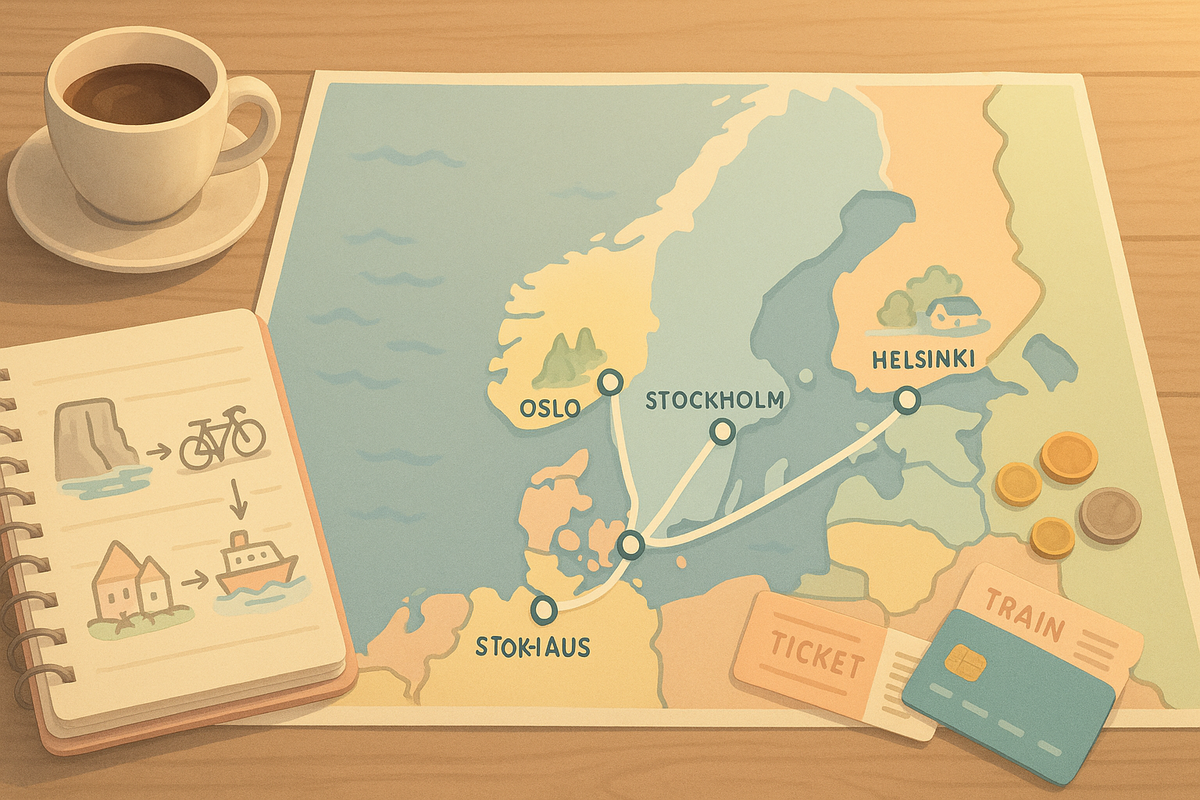
If you are planning a trip to Sweden and neighbouring countries, it is important to decide on several things at once: where your ‘base’ will be, how many capitals you want to visit, what seasons you will travel in, and what mini-trips you can add if you already live in the region. Below is a visual guide to the main decisions, followed by a step-by-step breakdown.
How to plan your route and budget by country
You can put together a Scandinavia trip in many different ways. Below are four key choices that shape both your route and the overall trip budget.
One trip — four countries
a route starting in Sweden
A classic Scandinavia route: base yourself in Stockholm, then head to Oslo and the fjords, take a train or bus to Copenhagen, and a ferry to Helsinki. A clear travel logic helps you avoid overpaying for chaotic transfers.
Base or capital-hopping
accommodation strategy
Staying in one country (for example, Sweden) and making trips to neighbors is often cheaper than changing city and hotel every 2–3 days. Fewer moves mean less stress and lower expenses for transport and accommodation.
When Scandinavia is cheapest
season and prices
The shoulder seasons (spring and autumn) offer the best balance of weather and prices. Summer, Christmas, and winter holidays raise the cost of hotels and activities, especially in Norway and Lapland.
If you already live in the region
mini trips to neighbors
For residents of Stockholm, Oslo, Copenhagen, and Helsinki, ideal weekend formats are within easy reach: ferries to neighboring capitals, short train trips, and even shopping and “alcohol” runs.
🔁 One trip — four countries: an example of a route starting in Sweden
The most logical route through Scandinavia for first-time visitors is to start in Sweden. Stockholm has convenient flight connections to Europe, and from there you can build an arc through neighbouring countries:
– Stockholm → train or bus to Oslo, from where it is easy to reach the fjords;
– Oslo/fjords → flight or train to Copenhagen with a possible stop in Gothenburg or Malmö;
– Copenhagen → train to Stockholm or ferry/combined route to Helsinki.
This trip through Sweden and neighbouring countries offers a good balance: you get to see the capitals and a little bit of nature in each country without spending too much time and money zigzagging across the map. Sweden remains a natural hub — it is convenient to fly in and out of.
⚖️ Which is more cost-effective: staying in one country or hopping between capitals
There are two basic strategies that determine how to plan your budget by country:
- Base in one country (often Sweden)– you live in Stockholm or another large city and make trips to neighbouring countries for a few days;– you book accommodation for a longer period in one place (often cheaper than constantly moving around) ;– you spend less on transport and logistics, making it easier to keep your budget under control.
- Quick hops between capitals– 2–3 nights in each capital: Stockholm, Oslo, Copenhagen, Helsinki;– more experiences in a short period of time, but higher transport and hotel costs in the most expensive cities; – higher risk of getting ‘tired’ of packing/moving and paying for spontaneous tickets.
If the goal is a conscious, not too stressful trip, then for your first trip to Scandinavia, it is convenient to choose a base in Sweden and add 1-2 neighbouring countries to it, and then ‘catch up’ on the rest on your next trip.
📅 When is Scandinavia cheapest?
Seasonality has a significant impact on the budget for each country. In general terms:
– High season in summer (approximately June to August) — the highest prices for accommodation and transport, especially in Norway and popular resorts. However, the days are long and the weather is at its mildest.
– Winter holidays and Lapland — December–January in Finland and northern Norway/Sweden are significantly more expensive due to Christmas tours, skiing and hunting for the Northern Lights.
– Off-season (spring and autumn) — the best choice if you want to see cities and nature at more reasonable prices and with fewer people.
When planning your itinerary, it is useful not only to look at the calendar, but also to spread out the expensive regions (fjords, Lapland, capital cities) and the more affordable ones by date — this will make your overall budget for travelling in Scandinavia more comfortable.
🏡 If you already live in the region: mini-trips to neighbouring countries
If you live in Stockholm, Oslo, Copenhagen or Helsinki, you have a whole range of mini-formats at your disposal:
– Stockholm ↔ Helsinki — a classic night ferry: it is both a means of transport and a short trip, offering the opportunity to take a ‘mini-cruise’ without flying;
– Copenhagen ↔ Malmö — just one bridge and you're in another country; the perfect format for a day or weekend trip;
– Oslo ↔ Gothenburg / Stockholm — convenient trains and buses allow you to easily change the ‘scenery’ without long flights;
– short shopping and ‘alcohol’ trips on ferries and trains, which residents of the region actively use for inexpensive getaways.
Such mini-trips also work well as ‘reconnaissance’ before a longer trip around Scandinavia: you can test the format, understand your comfort level in terms of cost, and then plan a longer trip around Sweden and neighbouring countries.
💡 Money-saving tips for Scandinavia without compromising on experiences
Even if the region is expensive, how to save money in Scandinavia is a solvable problem. The key principle is to save on the ‘shell’ (accommodation, food, transport), but not to cut back on the experiences that are the whole reason for travelling to the northern countries. This way, even a fairly modest budget can be turned into a very fulfilling trip.
These tips work for those planning a budget trip to Sweden, as well as for those who need practical life hacks for travelling to Norway, Denmark, and Finland. Below is a compact visual checklist, followed by a breakdown of each point.
Money-saving hacks in Scandinavia without losing the experience
You can save smartly: choose accommodation and your meal format wisely, plan transport in advance, and keep budget for what truly stays with you — fjords, archipelagos, ferries, and winter activities.
How to save on accommodation
early booking and choosing the right area
Book accommodation early, especially for summer and Christmas, check cashback services, and look at neighborhoods slightly outside the tourist center but close to metro or tram lines. This can make nights in the capitals noticeably cheaper.
Food and alcohol: where not to overpay
supermarkets and sensible dinners
Lean on supermarkets and bakeries, choose lunches over expensive dinners, and don’t turn alcohol into a separate budget category. This way your daily spend can easily drop by dozens of euros without sacrificing the experience.
Transport and city cards
travel passes and city passes
Multi-day travel passes, combined train+ferry tickets, and city cards in the capitals can save you a lot if you ride often and love museums.
What you shouldn’t save on
the main highlights of the trip
Norwegian fjords, Swedish and Finnish archipelagos, ferries between capitals, winter activities, and the Northern Lights are the things worth setting aside a separate budget for. They’re what make a northern journey truly special.
🏨 How to save on accommodation
Accommodation is one of the main expenses, so this is where it is easiest to see how to save money in Scandinavia without sacrificing comfort. There are several basic techniques that work:
- Early booking. Prices rise quickly in summer, at Christmas and during the winter holidays, especially in Norway and Lapland. If you book hotels or apartments at least a couple of months in advance, the difference in price will be very noticeable.
- Choosing a neighbourhood. In Stockholm, Oslo, Copenhagen and Helsinki, it makes sense to look not only at the city centre, but also at areas within 1-2 metro/tram stops: the infrastructure is the same, but the price per night is usually lower.
- Accommodation format. For those planning a budget trip to Sweden and neighbouring countries, hostels with private rooms, apartments and small guest houses work well. Where there is a kitchen, it is automatically easier to save on food.
If you wish, you can connect to cashback services and loyalty programmes offered by booking platforms — on a long route through Scandinavia, this also significantly reduces the total cost.
🍽️ Food and alcohol: where not to overpay
The second major expense is food. If you dine at a restaurant every day and order alcohol, even the most careful budget will quickly ‘balloon.’ Here are some simple but effective life hacks for travelling to Norway, Denmark, Sweden, and Finland:
- Supermarkets and bakeries. Large cities in the region have excellent supermarkets with ready-made meals, salads, hot dishes and baked goods. You can buy breakfast and some dinners there, and only go to restaurants for ‘special’ evenings.
- Lunch instead of dinner. Many cafes and bistros in Scandinavia offer great lunch menus: the same dishes as in the evening, but at a much lower price. It makes sense to make a hot lunch your main meal and simplify dinner.
- Alcohol. In Norway, Sweden and Finland, alcohol is expensive and can only be purchased in specialised shops. From a budget perspective, the simplest life hack is to drink less and choose your drinks wisely.
Together, these decisions can easily save you tens of euros a day and make your food bill predictable.
🚆 Transport and city cards
Transport in Scandinavia is well developed, but buying tickets on the spur of the moment can quickly eat into your budget. To make sure that life hacks for travelling to Norway, Denmark and Finland work here too, there are a few things to keep in mind:
- Travel cards and temporary tickets. If you are actively travelling around the city, it is more profitable to buy a day or multi-day travel card than to buy single tickets. This is especially true in Stockholm, Copenhagen and Helsinki.
- Combined tickets. Some operators offer ‘train + ferry’ or ‘train + bus’ tickets between countries. This is convenient if you are planning a route through several countries at once.
- City pass cards. Stockholm Pass, Copenhagen Card and other city cards combine public transport and admission to major museums. They really pay off if you are planning a busy itinerary: 2-3 paid locations per day plus active trips around the city.
If your strategy is to walk more and simply ‘soak up’ the atmosphere, you don't need to buy a city pass and can limit yourself to single tickets or a simple travel card.
⭐ What is definitely worth the money
It's wise to save money, but there are some things where it's better not to try to ‘save a few quid’ because they are what make a Scandinavian trip unique:
Norway. Fjords, panoramic railways, cruises and mountain trekking routes — this is a case where it's really worth investing in a good tour or logistics. Denmark. Design, gastronomy, the atmosphere of Copenhagen and cosy towns — it's not just about free walks, but also about carefully chosen restaurants, coffee shops and museums. Finland. Northern lights, Lapland, winter safaris, island archipelagos and traditional saunas. These experiences require a separate budget, but they will be remembered for a lifetime.
A good rule of thumb: if you have a choice between another ‘average’ restaurant or a trip to the fjords, the archipelago or Lapland, always choose the experience. Then your budget trip to Sweden and neighbouring countries will remain both reasonable in terms of money and truly memorable.
✨ Scandinavia – an investment in experiences
Scandinavia is certainly not one of the cheapest destinations, but it is not an ‘exclusive club for the select few.’ If you understand the price levels, plan your travel budget by country, take advantage of seasonal discounts, and make informed choices about accommodation, food, and transport, the region ceases to seem prohibitively expensive and becomes a well-considered investment in experiences.
In this article, we've gone from a general price comparison to an approximate daily budget by country, figured out where most of the money goes, and put together a set of life hacks. Next up is the route: there are many ways to plan a route through Scandinavia, but it makes sense to start with Sweden as a natural starting point and convenient hub.
Now there is only one step left to take — choose which country you will start your northern journey from and delve into detailed guides on routes and budgets.
Choose your starting country
Start with Sweden or add its neighboring countries. Below is a short overview, and then you’ll find detailed guides to routes and budgets.
Sweden
a convenient hub for traveling around Scandinavia
Stockholm and other cities are well connected to Norway, Denmark, and Finland. An ideal base for combining cities, archipelagos, and trips to neighboring countries.
Norway
fjords, mountains, and scenic routes
If you want to focus on fjords, scenic roads, and nature, head to our Norway guide — with routes, seasons, and budget planning.
Denmark
design, gastronomy, and cozy cities
Interested in design, gastronomy, and an easy urban rhythm? Take a look at our Denmark guide — Copenhagen, coasts, and smaller cities with a clear budget.
Finland
Lapland, saunas, and archipelagos
For the Northern Lights, winter activities, and island archipelagos — head to our Finland materials and build your route north.
Pick your starting point — and we’ll help tailor the route and budget to your plans.