

🌍 Scandinavia for the first time: Sweden, Norway, Finland or Denmark — which country to start your journey with
🗺 Scandinavia for the first time
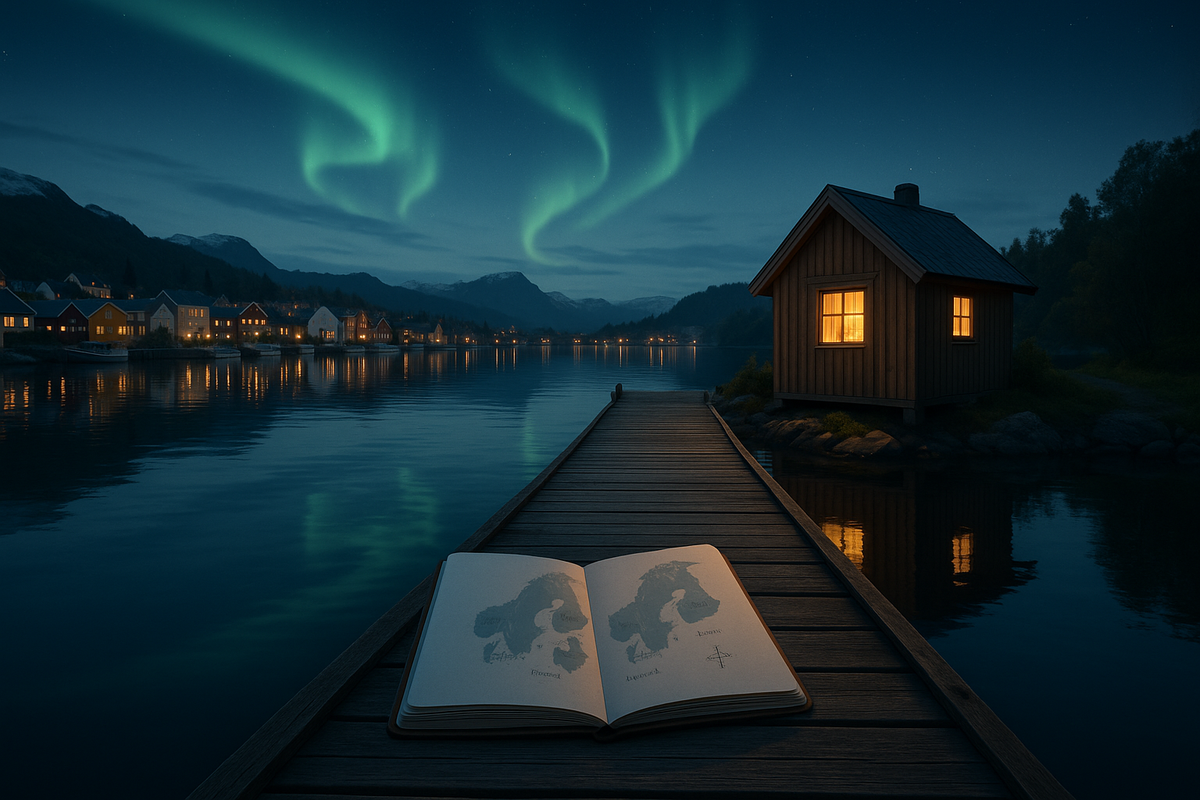
You dream of the northern lights, wooden houses by lakes and cosy towns on the water — and now you are planning your first trip to Scandinavia. It seems simple enough: buy a ticket to the North and fly there. But even at the research stage, doubts begin to creep in: which of the best Scandinavian countries should you choose first — Sweden, Norway, Finland or Denmark? Where should you go first, and what kind of trip should you start with?
✨ Why you should plan your first trip to Scandinavia
Scandinavia offers a rare combination: wild nature and very convenient infrastructure. It is safe here, English is spoken almost everywhere, and it is easy to travel by train, ferry, and rental car. In summer, there are white nights and long walks; in winter, there is snow, the northern lights and cosy hygge. In one trip, you can combine a city weekend in Copenhagen or Stockholm with the fjords of Norway and the lakes of Finland.
🧭 Which countries are usually chosen first?
The first trip to Scandinavia usually looks like this:
- Norway— if you want to experience nature and fjords to the fullest.
- Sweden — a balance of ‘city + nature’, with a convenient start in Stockholm.
- Finland — lakes, saunas and Lapland with the northern lights.
- Denmark — a comfortable and stylish city weekend in Copenhagen.
People often start with one country, then return and gradually discover the other best countries in Scandinavia.
❓ What questions should you ask yourself before making a choice?
To decide where to go — Norway, Denmark, Finland or Sweden — ask yourself a few questions:
- What do you prefer: cities, nature or a mix?
- When are you planning to travel: summer with white nights or winter with the northern lights?
- What is your budget and how many days do you have — a weekend, a week, 10–14 days?
- Are you willing to rent a car or would you prefer to use public transport?
- Are you travelling alone, as a couple, with friends or with children?
🌍 What do Scandinavian countries have in common and what to expect from a trip there
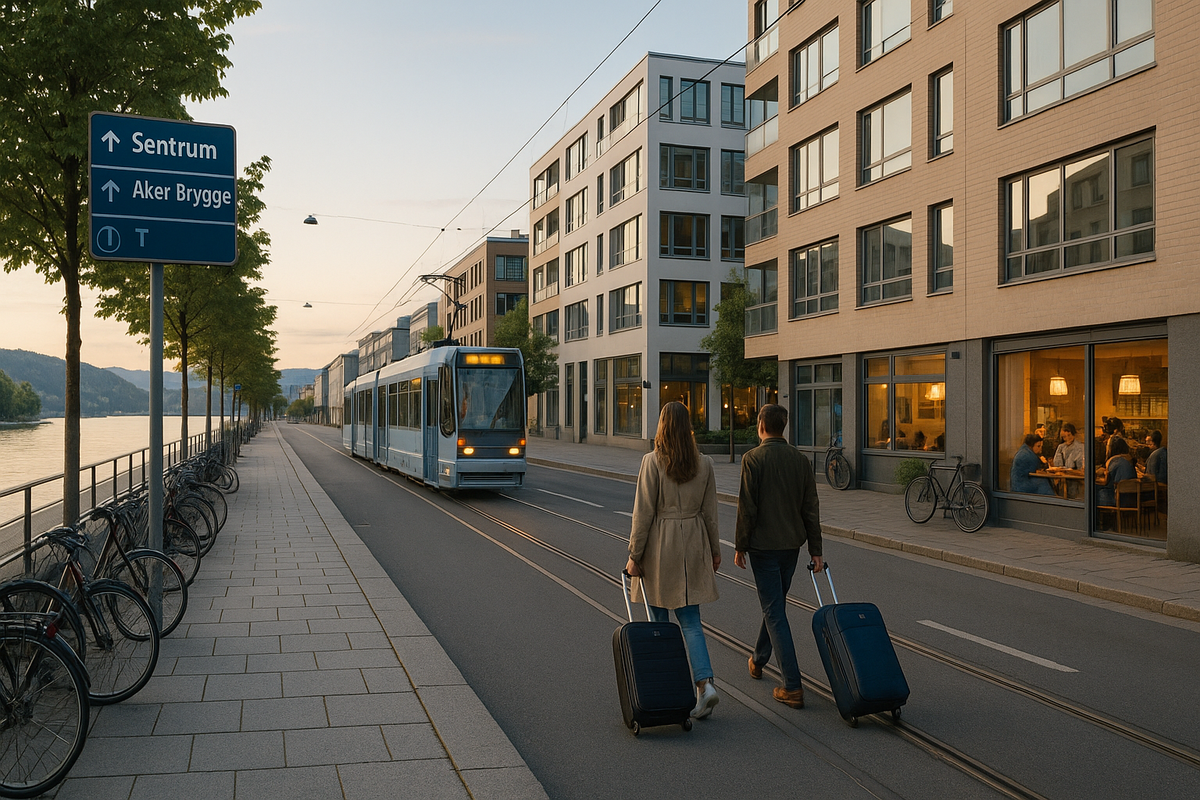
The Scandinavian countries are more similar than they appear on the map: high levels of safety, a love of nature, a sustainable lifestyle and very comfortable infrastructure for travellers. Wherever you go on your first trip to Scandinavia — Sweden, Norway, Finland or Denmark — you will find clean cities, convenient transport, easy-to-follow routes and a sense of calm northern comfort.
🌤️ Climate, seasonality and polar day: when is the best time to visit for the first time?
To make it easier to choose the season for your first trip to Scandinavia, take a look at this brief guide to the climate and experiences by season:
| Season | What to expect | For a first visit |
|---|---|---|
| Summer | Mild weather, around +15…+22 °C, long daylight hours, in the north – white nights. | The best option for a first visit: easy to combine cities and nature. |
| Autumn | Cooler weather, vivid foliage, fewer tourists, possible rain. | Good for relaxed trips and hiking if you are not afraid of changeable weather. |
| Winter | Snow, short daylight hours, frost, a chance to see the northern lights. | Perfect for Lapland, winter holidays and snow activities. |
| Spring | A transitional season: snow melting, more daylight, but the weather can change. | Good for those who want peace and quiet, fewer tourists and lower prices. |
💶 Prices, transport, language barrier: practical details for beginners
When planning your first trip to Scandinavia, it is important to consider three things in advance: how much everything costs on average, how you will get around, and how easy it will be to communicate locally.
- Prices. Scandinavia is more expensive than most European destinations: food, alcohol and hotels are more expensive. However, the quality is almost always high. You can save money by booking accommodation in advance, choosing apartments instead of hotels, eating lunch menus and using city passes.
- Transport. Public transport works very well in Sweden, Norway, Denmark and Finland: trains, buses, metros and ferries. Tickets can be conveniently purchased in apps or at stations, and timetables are reliable. It is not necessary to rent a car for your first trip to Scandinavia, but it does give you more freedom when travelling to nature-oriented regions.
- Language barrier. In the best Scandinavian countries, almost everyone speaks English, from baristas to bus drivers. Road signs and information in museums are also often duplicated in English, so travelling to Sweden, Norway, Denmark or Finland is comfortable even without knowledge of the local languages — a couple of polite phrases for ‘thank you’ and ‘hello’ are enough.
🧳 Typical travel formats
The easiest way is to choose not a country, but a type of holiday — and then decide where to go in Scandinavia first.
- Road trip. Rent a car and take a route through the fjords of Norway, the forests of Sweden or Finland, or the coast of Denmark. Maximum freedom: you can stop in small villages, at viewing platforms and by lakes. This format is especially good in summer and early autumn.
- Cities + nature. A classic for your first trip to Scandinavia: a few days in the capital and 1-2 trips to the countryside. For example, Stockholm + the archipelago, Oslo + the fjords, Copenhagen + castles and the coast, Helsinki + the islands or the lake district.
- Winter holidays. A fairy-tale format: Lapland in Finland or Norway, the northern lights, dog sledding, Christmas markets. This type of trip is suitable for those who dream of a real winter and are not afraid of short daylight hours.
Once you have decided on the format, it is much easier to understand where to go — Norway, Denmark, Finland or Sweden — for your ideal ‘first north’.
🧭 How to choose which country to start your journey in Scandinavia from
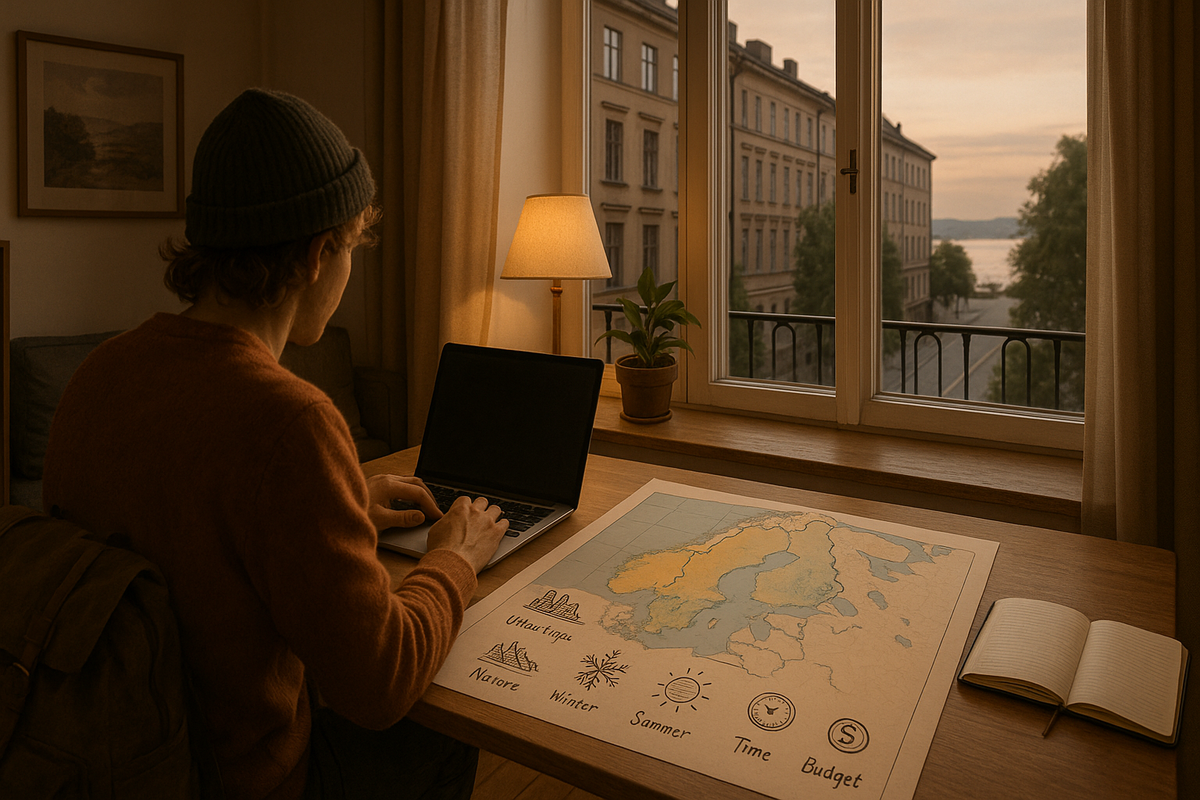
Once you have a rough idea of what to expect from the northern climate, prices and types of holidays, the main question arises: which country to start your Scandinavian journey from. There is no universal answer — much depends on whether you prefer cities or wild nature, what season you plan to travel in, and how much time and budget you have. In this section, we will break down the choices according to simple criteria — interests, season, duration, and type of itinerary — to make it easier for you to decide where to go for the first time.
🎯 Interests: nature, cities, gastronomy, family holidays, active tourism
The easiest way to choose which country to start your Scandinavian journey in is to think about what you want to see and experience first.
- If you want to experience nature and fjords to the fullest, start with a trip to Norway. This is the best option for those who dream of mountains, viewing platforms, serpentine roads and dramatic landscapes by the water.
- If you want a balance of city and nature, Sweden is a good place to start. A trip to Sweden can easily be combined with walks around Stockholm, the archipelago islands, forests and lakes just an hour or two from the capital.
- If you love lakes, saunas and a relaxed pace, choose Finland. Your first trip to Finland will be all about silence, forest trails, cottages by the water and evenings in the sauna, and in winter, Lapland with the northern lights.
- If design, gastronomy and a short weekend are important, Denmark is ideal. It is convenient to start your trip to Denmark in Copenhagen: stylish cafes, local cuisine, bike rides and the sea are literally ‘at your doorstep’.
- If you are travelling with children, consider Finland and Denmark first. Finland offers Lapland, Santa Claus and winter activities, while Denmark has amusement parks and very family-friendly cities.
Step by step, it becomes clearer where to go for the first time so that your first trip to Scandinavia matches your personal interests as closely as possible.
🌤️ By season: where to go in summer, autumn, winter and spring
The season largely determines which country to start your first trip to Scandinavia with and what kind of atmosphere you will experience.
- Summer. A universal option for your first trip to Scandinavia: mild weather, long daylight hours, and white nights in the north. In summer, you can safely choose any country — travel to Norway to see the fjords, to Sweden with its archipelagos, to Finland to see the lakes, or to Denmark to see the coast and cities.
- Autumn. A quieter and more atmospheric season: golden forests, fewer tourists, sometimes changeable weather. Sweden and Norway are the best places to visit — trips to the forests, mountains and fjords, short treks, cosy evenings in the cities.
- Winter. If you dream of a winter wonderland and the northern lights, then the logical choice is Finland and northern Norway or Sweden. A winter trip to Finland or Norway means Lapland, snow, reindeer, dog sleds and Christmas spirit.
- Spring. A mild season for city trips: not too many tourists yet, but more light and activity. Short trips to Copenhagen, Stockholm, Oslo or Helsinki are a great way to ‘try on’ Scandinavia for a few days and figure out where to go next time.
⏱️ By duration and budget: weekend, week, 10–14 days
How many days you have and what budget you are willing to set aside directly affects which country you should start your first trip to Scandinavia with.
- Weekend (2–4 days).The optimal format is one capital city. This could be a short trip to Copenhagen, Stockholm, Oslo or Helsinki: fly in, stroll around the city centre, visit museums, walk along the waterfront and get a feel for Scandinavia at your own pace.
- A week.This is enough time to get a deeper insight into one country: city + nature. For example, a trip to Sweden: Stockholm and the archipelago; to Norway: Oslo and the fjords; to Finland: Helsinki and the lake district; to Denmark: Copenhagen and castles/coast. Or two cities in different countries, if you want to travel more.
- 10–14 days.Here you can already plan your first ‘Scandinavian ring’ — a route through 2–3 countries. For example, Copenhagen – Oslo – fjords – Stockholm or Stockholm – Helsinki – Lapland. This format requires a larger budget, but allows you to see several of the best countries in Scandinavia in one trip and understand where you would like to return to separately.
🗺️ Ready-made scenarios:
If you don't want to spend hours piecing together your itinerary, you can rely on ready-made formats — from a short weekend to a two-week ‘Scandinavian ring’. Below are three simple scenarios that will help you quickly understand which trip to Sweden, Norway, Finland or Denmark is right for you for your first time.
to Scandinavia
These three scenarios cover the main requirements of those planning their first trip to Scandinavia.
🌅 ‘My first weekend in the north’ is suitable if you only have 3-4 days and just want to ‘try out’ a trip to Copenhagen, Stockholm, Oslo or Helsinki.
🚆 ‘Classic week-long trip to Scandinavia’ is an option for those who are ready to combine the capital and nature in one country.
🔁 And the ‘Grand Scandinavian Loop’ is worth choosing if you have 10-14 days and want to see 2-3 countries at once and decide where to return to next time — Norway, Denmark, Finland or Sweden.
🌲 Sweden: a gentle start to your first trip to Scandinavia
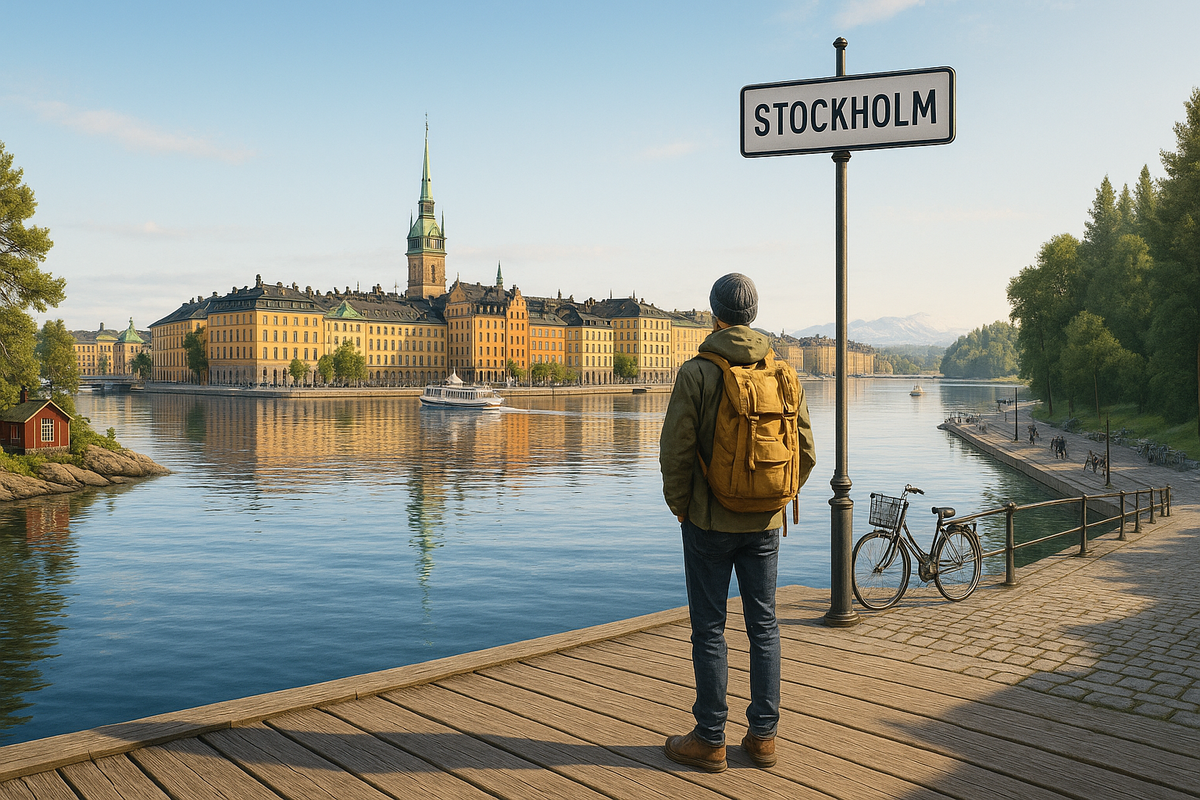
Sweden is one of the easiest and most comfortable options for your first trip to Scandinavia. Here, you can easily combine atmospheric Stockholm, walks around the archipelago, trips to forests and lakes, and, depending on the season, an introduction to Lapland. If you want to start your northern journey without stress, with good infrastructure and a clear balance between city and nature, travelling to Sweden is a very logical choice.
👥 Who would enjoy a trip to Sweden?
Sweden is the right choice if you:
- love cities by the water, old town centres, Scandinavian design and cosy cafés;
- want a balance of ‘city + nature’ in one trip, without long flights and transfers;
- are planning your first trip to Scandinavia without renting a car and want to rely on trains, ferries, and city transport;
- are looking for a quiet and safe destination for a trip with your partner, friends, or family;
- you want your trip to Sweden to be a comfortable ‘introduction to the North’, without a sudden change in pace and culture.
🗺️ Key facts about the country: Stockholm, archipelagos, forests and lakes, Lapland
A trip to Sweden usually begins in Stockholm, but this country also offers cosy northern towns, wild nature and almost polar landscapes. It is convenient to keep in mind four ‘worlds’ around which you can build your itinerary.
- Stockholm. The capital city on the islands with a beautiful old centre, embankments, museums, and modern Scandinavian design. It is a comfortable starting point for your first trip to Scandinavia.
- Archipelagos. The Swedish archipelago consists of hundreds of islands with villages, lighthouses and summer cottages. It is easy to arrange a day trip by ferry from Stockholm and add a touch of the maritime North to your ‘urban’ itinerary.
- Forests and lakes of central Sweden. Just a couple of hours from the capital, you will find quiet forests, lakes and wooden houses by the water. This is the perfect destination for those who want to complement their trip to Sweden with trekking, kayaking and evening saunas.
- Lapland. Northern Sweden is Lapland with winter, snow, the chance to see the northern lights and winter activities. In summer, people come here for the polar day, mountains and long trails far from the hustle and bustle of the city.
⚖️ Pros and potential cons for beginners
Advantages of travelling to Sweden for beginners
- Logistics. Convenient flights, easy-to-understand public transport, well-organised trains and ferries — it's easy to plan your first trip to Scandinavia without any stress.
- Safety. A peaceful atmosphere, neat cities, and a high level of service make it comfortable to travel as a couple, a family, or even alone.
- English. English is spoken almost everywhere, so travelling to Sweden does not require knowledge of Swedish — basic English is sufficient.
- Balance of city and nature. In one itinerary, you can combine Stockholm, the archipelago, and trips to lakes and forests — without long flights or changing countries.
What might be confusing
- Prices. Sweden is more expensive than many European destinations: this is especially noticeable in restaurants and hotels, although the quality is high.
- Weather. Summers can be cool and windy, and in spring and autumn the weather can change quickly, so you should always bring layers and a raincoat.
- Distances in the north. If you want to add Lapland to your itinerary, you will have to factor in a domestic flight or a long train journey and slightly increase your budget and the duration of your trip.
🧳 Mini itinerary ideas: ‘city + nature’ for 3–7 days
To illustrate what a 3–7-day trip to Sweden combining city and nature might look like, it is convenient to present it in the form of three ready-made mini-scenarios. Click on the stickers — they will ‘flip over’ and show the details of the itinerary.
Stockholm + archipelago
Stockholm + nature
🏔️ Norway: fjords, mountains and dramatic landscapes for those who dream of nature
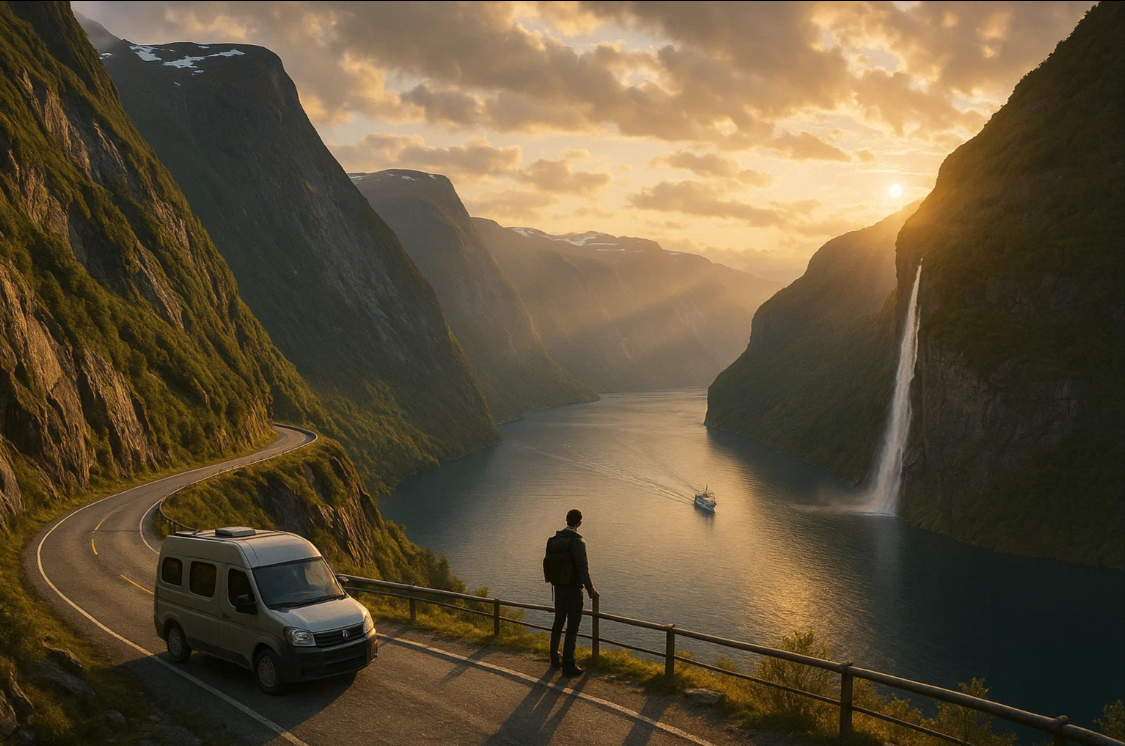
Norway is Scandinavia at its best: fjords, mountain plateaus, waterfalls and panoramic roads where every turn looks like a postcard. A trip to Norway is especially well suited for those who want to start their first trip to Scandinavia with nature and outdoor activities rather than big cities. Everything here is geared towards ‘wow landscapes’: from fjord cruises to hiking and road trips along the sea and mountains.
🎯 When Norway is the best choice for your first time
Norway is the right choice if you:
- want to experience as much nature and as few big cities as possible — you imagine your first trip to Scandinavia not in museums, but among mountains, water and fog;
- dream of fjords, viewing platforms, waterfalls and mountain roads — a trip to Norway gives you that ‘wow effect’ almost every day;
- are ready for activities: hiking, walking along trails, boat trips along the fjords, road trips between small towns;
- are planning a trip in summer or early autumn, when the roads are open, the weather is milder and the days are longer;
- be prepared for a slightly higher budget for a nature-oriented trip, taking into account the cost of accommodation, transport, car rental and ferries.
🌊 Must-see attractions when travelling in Norway: fjords, Lofoten Islands, national parks
To make your first trip to Norway truly memorable, simply include a few ‘key’ attractions in your itinerary — from classic fjords to northern islands and panoramic roads.
- Fjords of Western Norway. A cruise through the fjords of Norway (for example, Geiranger, Nærøy, Sognefjord) is almost a must: sheer cliffs, waterfalls, tiny villages by the water and the feeling of the real northern edge.
- Lofoten Islands. Lofoten is dramatic mountains cutting into the sea, fishing villages with red houses and white sandy beaches. A trip to Norway with a stop in Lofoten is suitable for those who love the combination of sea, mountains and atmospheric villages.
- National parks and trekking. Routes in Norway's national parks allow for easy day treks with views of fjords, glaciers and plateaus. This is a way to add active recreation to your trip without having to be a ‘trained mountaineer’.
- Panoramic roads and fjord cruises. Famous tourist roads with viewing platforms and serpentine roads (such as the Trollstigen) go well with boat trips on the fjords. This format allows you to see the country from both the water and above.
⚠️What to pay attention to: weather, prices, car hire and ferries
Norway has its own nuances, which are best taken into account in advance so that your first trip to Norway goes smoothly and without surprises.
The main things to consider are:
- Weather. It changes quickly, even in summer: you can see sun, rain and fog in one day, especially near the fjords. Always take layers, a waterproof jacket and comfortable shoes.
- Prices. Prices are higher than the European average, especially for restaurants and alcohol. To stay within your budget, it is worth booking accommodation in advance and combining cafés with ready-made meals from supermarkets.
- Car rental. For fjords and scenic roads, a road trip through Norway gives you maximum freedom, but significantly increases costs (fuel, insurance, parking). A good option if you are willing to invest in convenience.
- Ferries and road tolls. On many routes through the fjords of Norway, you cannot do without ferries and toll roads. It is better to take these costs into account in your budget and travel time right away.
🧭 Route ideas: where to go in Norway for 5–10 days
Below are three examples of where to go in Norway for 5–10 days. The itineraries are hidden on the back of the stickers: click to see the route details.
Oslo + fjords
Western fjords & roads
North & Lofoten
🔗 ‘A Detailed Guide to Norway’
If you want to learn more about routes, seasons and budgets, check out our blog about Norway, which contains detailed reviews of the fjords, Lofoten and scenic roads, as well as practical tips for planning your trip.
🧖♀️ Finland: lakes, saunas and magical Lapland

Finland is Scandinavia at its most peaceful and cosy: lakes and forests, cottages by the water, the obligatory sauna and a sense of tranquillity all around. A trip to Finland is often chosen by those who want to slow down, spend time in nature, but at the same time not sacrifice comfort and understandable infrastructure. And in winter, people come here for the fabulous Lapland, snow, the northern lights and a meeting with the ‘real’ Santa Claus.
🎯 Who would enjoy their first trip to Finland?
Finland is a good choice if you:
- want a peaceful, ‘slow’ holiday by the water and in the forest, without rushing to see dozens of attractions;
- love saunas, fireplaces, country cottages and the ‘cottage + nature’ format as the basis for your trip;
- are planning a family trip, including with small children, and appreciate simple, straightforward infrastructure;
- dream of winter in Lapland, snow, the northern lights and, perhaps, meeting Santa Claus;
- value safety, simple logistics and minimal cultural ‘stress’ — so that your first trip to Finland is as comfortable as possible.
☀️❄️ Summer and winter: lake district, trekking, northern lights and Santa Claus in Lapland
Finland can be divided into two seasons: ‘summer by the lakes’ and ‘winter in Lapland’ — plus Helsinki and the coast, which can be visited all year round. This helps you quickly understand where to go in Finland in summer and winter.
- Summer and off-season — lake district and trekking. The warm season is the perfect time to visit the lake district: forests, national parks, trekking trails, kayaking, cycling and evenings in the sauna by the water. This format is especially good for those who want a quiet holiday in nature.
- Winter — Lapland, the Northern Lights and Santa Claus. A winter trip to Finland most often takes you to the Rovaniemi, Levi or Jullas area, where you can ride reindeer and dog sleds, hunt for the Northern Lights and visit Santa Claus' village. This is an option for those who dream of a real winter fairy tale.
- Helsinki and the coast. Helsinki is a convenient addition to both summer and winter trips: walks around the city, sea breezes, island fortresses such as Suomenlinna, cafes and design shops. The capital can be easily combined with a trip to other countries if you are planning a more complex route through Scandinavia.
👨👩👧👦 Family trips and a relaxed holiday format
Finland is ideal for family trips and for those who want to make their first trip to Scandinavia as relaxed and stress-free as possible.
- For families with children. Parks, zoos, theme centres and, of course, Lapland with its Santa parks and winter activities — there is plenty for children to do in any weather.
- For couples or groups of friends. A cottage by the lake, your own sauna, leisurely walks in the forest, fishing, kayaking and sitting by the fireplace — a great option if you want to recharge your batteries.
- Overall vibe. Quiet, safe, no mandatory race to see all the must-see sights: you set the pace yourself, and your trip to Finland becomes more of a rest and recuperation than a ‘sightseeing marathon’.
🧳 Route ideas: where to go in Finland for a weekend or a week
To make it easier to imagine where to go in Finland for a weekend or a week, below are three ready-made scenarios in the form of interactive stickers. Click on the cards to see what your first trip to Finland could look like – from a city break in Helsinki to a lakeside holiday and winter Lapland.
Helsinki + islands
lakes and sauna
🔗 More ideas for your trip to Finland
If you want to learn more about routes, seasons and budgets, check out our blog about Finland, which features ideas for trips to the lake district, Lapland and Helsinki, as well as practical tips for independent travellers.
🕯️ Denmark: cities, design and hygge for those who love comfort and short trips
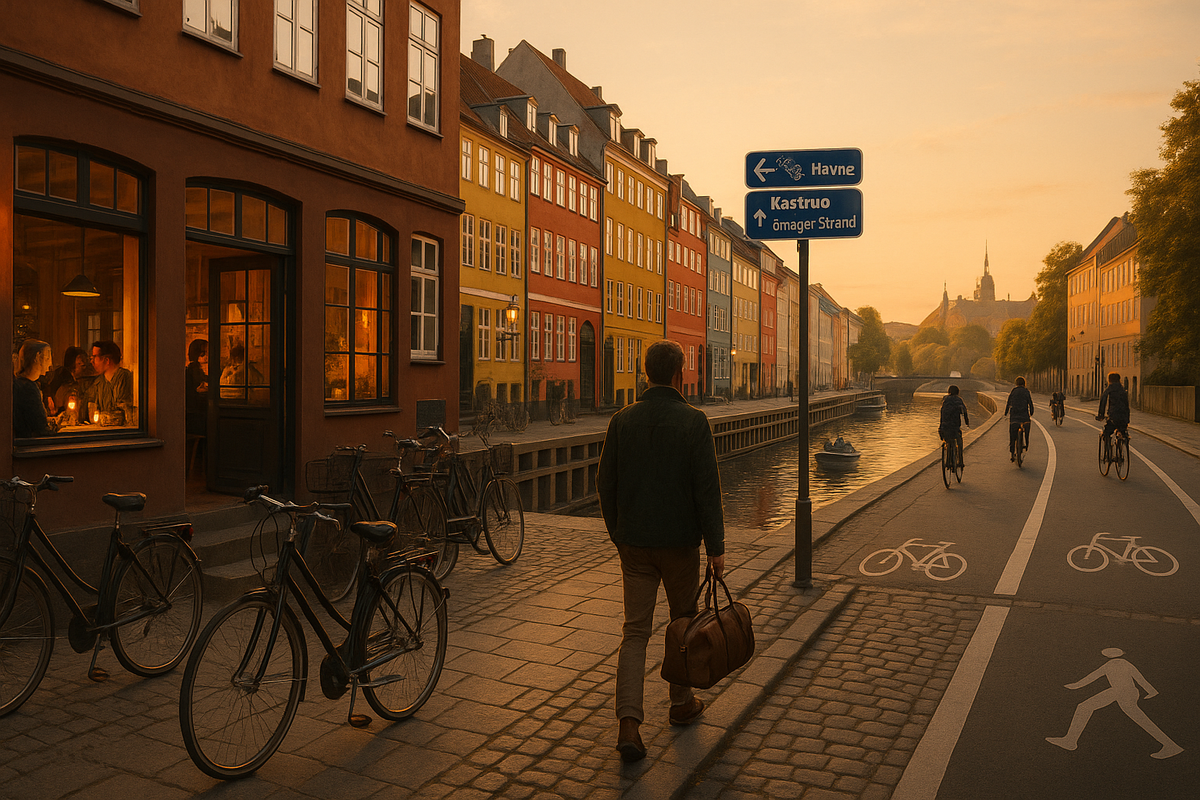
Denmark is the ideal country if you want to start your Scandinavian journey with a comfortable city weekend. Compact Copenhagen with its canals, cycle paths and hygge-style cafés, the sea just a few stops away from the centre and castles within easy day-trip reach — all this can easily be squeezed into a 3-4 day trip. A trip to Denmark is suitable for those who love design, gastronomy and a lively urban rhythm, but are not ready to dive straight into the harsh mountains and long journeys.
🚪 Why Denmark often becomes the ‘gateway’ to the best countries in Scandinavia
Denmark is a good choice if you:
- want to start your acquaintance with Scandinavia with a comfortable city weekend, without complicated transfers and the ‘extreme’ north;
- love design, gastronomy, cosy cafés and bike rides — a trip to Copenhagen can easily be turned into a stylish city mini-break;
- are afraid of complicated logistics: it is important for you to arrive, check in and just walk around, rather than changing from a train to a ferry;
- you are planning a short trip of 3-4 days and want to get the most out of your time in a compact format;
- you prefer a mild climate without severe frosts and mountain serpentines, but with the sea and fresh air nearby.
🚲 Copenhagen and its surroundings: city walks, the sea, castles and cycle paths
The first trip to Denmark almost always begins in Copenhagen, a city where you can conveniently combine walks through the historic centre, gastronomy, design, and short trips to the sea and castles of North Zealand.
- Copenhagen. The historic centre, Nyhavn waterfront with its colourful houses, walks along the canals, Tivoli Gardens, modern architecture and a strong gastronomic scene — from street food to famous restaurants.
- Castles and North Zealand. Day trips to Kronborg and Frederiksborg castles easily fit into a 3-4 day trip to Denmark and add a ‘fairytale’ touch to the itinerary.
- The sea and the coast. The beaches and promenades near Copenhagen allow you to literally switch from the city rhythm to walks by the water and picnics in just half an hour to an hour.
- Cycle paths and lifestyle. Copenhagen is one of the most bicycle-friendly cities: grabbing a bike and getting around like the locals is an easy way to experience the Danish lifestyle and that very hygge in everyday life.
📅 Where to go in Denmark if you only have 3–4 days
To understand where to go in Denmark if you only have 3–4 days, it is useful to look at three typical scenarios — all of them are based around Copenhagen and short trips. Below are interactive stickers: click on the card to see the route details.
(2–3 days)
(3–4 days)
/ Malmö (3–4 days)
✅ Advantages for beginners: compact size, logistics, mild climate
Denmark is a convenient ‘first step’ into Scandinavia if you just want to fly in, check in and enjoy the city, rather than spending time on complicated planning and long journeys.
- Compactness. Most of the interesting sights are located within a short distance from Copenhagen: the city centre, castles, the sea and even another country (Malmö) — everything is nearby.
- Logistics. A convenient airport, efficient public transport, easy-to-understand tickets and timetables — it's easy to find your way around, even if you rarely travel independently.
- Mild climate. There are no extreme cold spells or heat waves: most of the year, it's comfortable to walk around the city and along the coast, all you need is a windbreaker and comfortable shoes.
- English. Almost everyone speaks English fluently, so your first trip to Denmark does not require any special language skills.
- What might be confusing. Prices are above the European average, and the weather can be windy and changeable, so it is best to bring warm clothes and a waterproof jacket with you.
🔗 ‘Ideas for travelling in Denmark’
If you want more ideas for short trips, routes around Copenhagen and castles, as well as practical advice on the season and budget, check out our blog about Denmark.
📌 Comparative cheat sheet: which country to start your trip to Scandinavia from
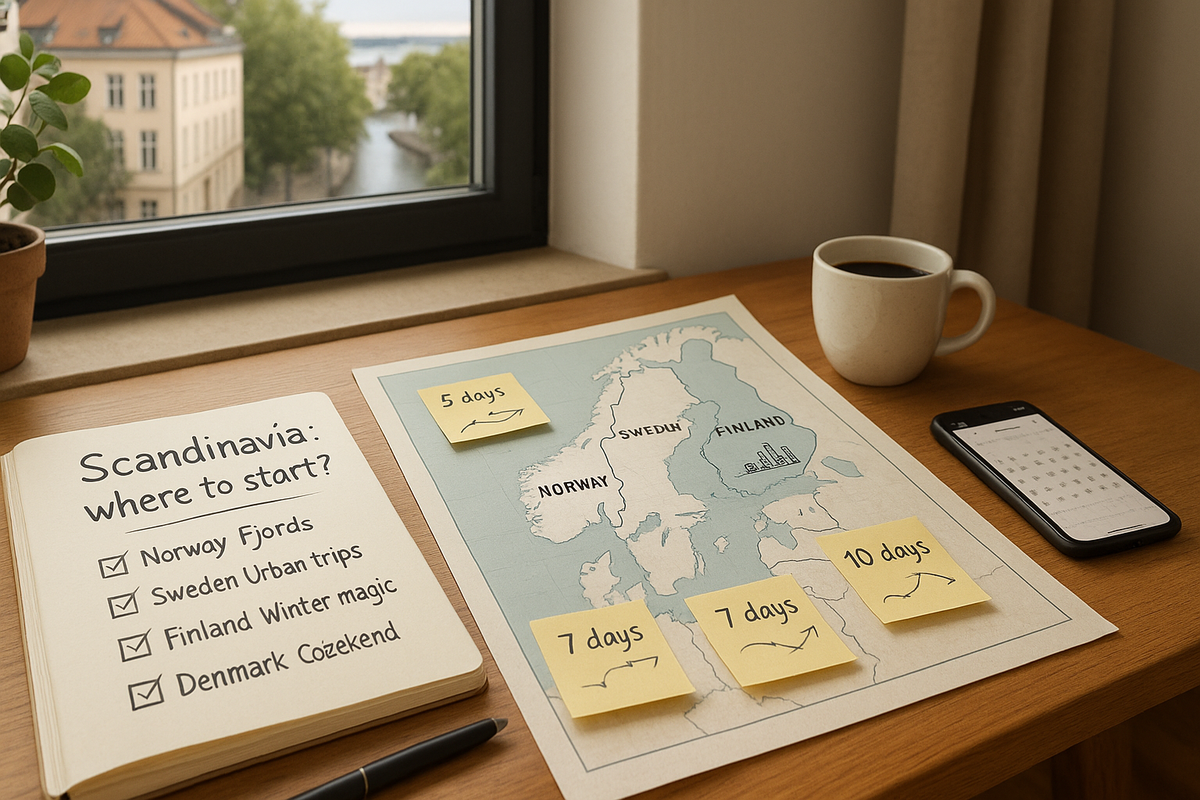
If you are still unsure which country to start your Scandinavian journey in, this section is a quick guide to help you choose. Below, we'll put together a list of which country is best suited to different needs, give examples of starting routes for 5, 7 and 10 days, and show you how to logically plan your second and third trips so that you can gradually cover all the best countries in Scandinavia.
✅ Selection table/checklist: ‘If you want to ___, start with ___’
To simplify your choice, use this cheat sheet: find your query in the first column and see which country is the best place to start your journey in Scandinavia.
| What you want | Which country to start with |
|---|---|
| Maximum nature and fjords | Norway — a trip to Norway for fjords, mountains and scenic roads. |
| Balance of city and nature | Sweden — a trip to Sweden with Stockholm, the archipelago and forests not far from the capital. |
| Winter fairytale and northern lights | Finland — a trip to Finland and Lapland for snow, saunas and the northern lights. |
| A short stylish weekend | Denmark — a trip to Denmark with a weekend in Copenhagen, design, cafés and sea air. |
🧳 Examples of ready-made starting routes for 5, 7 and 10 days
Below are three starting scenarios to help you quickly decide how to plan your first trip to Scandinavia according to your schedule and budget.
- 5 days.One city + a little nature. For example: a weekend in Copenhagen with a trip to the castles, a trip to Stockholm with a trip to the archipelago, or a short ‘Oslo + fjords light’ itinerary. This format is for those who want to ‘try on’ Scandinavia without taking a long holiday.
- 7 days.One country ‘in depth’: capital city + nature. This could be a week in Norway (Oslo and the fjords), a trip to Sweden (Stockholm and the islands/lakes), a trip to Finland (Helsinki and the lake district) or Denmark (Copenhagen and the coast). This itinerary gives you a full feel for the country.
- 10 days.Mini ‘Scandinavian Ring’ — 2–3 capitals and one natural region. For example, Copenhagen – Oslo – fjords – Stockholm or Stockholm – Helsinki – Lapland. This is a good option if you want to see several of the best countries in Scandinavia in one trip and figure out where to return to separately.
🔁 How to logically plan your second and third trips to cover all the best countries in Scandinavia
If your first trip to Scandinavia left you wanting more, it makes sense to think in advance about how to combine all the best countries in Scandinavia into 2-3 trips without repeating the same formats.
- If you started with Sweden. The logical second step is to travel to Norway for the fjords and mountains, and on your third trip, add Denmark or Finland for a more relaxed city and lake holiday.
- If Copenhagen (Denmark) was your first stop. Norway or Sweden are good choices next: you will add more nature, fjords, forests and lakes to the already familiar urban hygge.
- If you have already been to Finland in winter. Your next trip to Scandinavia is best planned around summer in Norway and/or Sweden: fjords, trekking, archipelagos and long daylight hours will give you a completely different experience than Lapland.
- If you went to Norway first. Your second trip could be a more ‘urban’ route — a trip to Sweden or Denmark, and your third — a return to Finland for lakes, saunas and a leisurely holiday.
In this way, over the course of two or three trips, you will gradually see Norway, Sweden, Finland and Denmark — and build up your own personal collection of northern impressions: from fjords and Lapland to cosy towns and seaside promenades.
🧩 What to do after choosing a country: practical steps and useful links
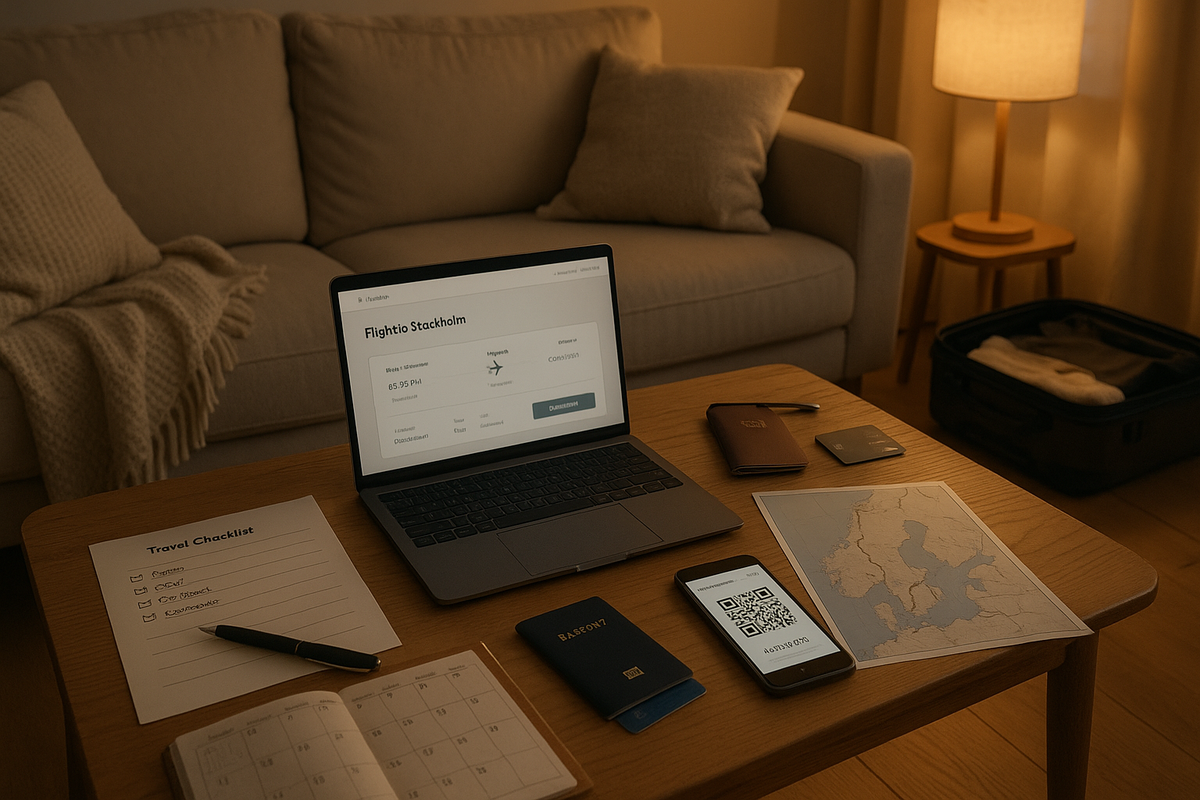
You've chosen your country — what next? Now comes the fun part: turning your idea of a trip to Scandinavia into a concrete itinerary — booking flights and accommodation, deciding whether you need a car, and figuring out the best way to buy excursions and activities. This section contains a short checklist of practical steps and useful links that will help you calmly get your plan to the stage where you have bought your tickets and all that's left is to wait for your flight.
✈️ When to book flights, accommodation, car hire and excursions
Booking times depend on the season and the specific country, but there are a few universal guidelines for your first trip to Scandinavia.
- Flights. For summer, New Year's holidays and Lapland, it is best to look for tickets 3–6 months before your trip; in the low season (spring, autumn), you can often find reasonable options 1.5–2 months in advance.
- Accommodation. In the capitals (Copenhagen, Stockholm, Oslo, Helsinki), it is best to book hotels and apartments 2-3 months before your trip, and country houses by the lakes and accommodation in Lapland during the peak season (Christmas, holidays, summer) - 4-6 months in advance.
- Car rental. If you are planning to visit the fjords of Norway, the lake district of Finland or a road trip through Sweden/Denmark in the summer, it is worth booking a car at least 1-2 months in advance, and even earlier during the high season, to ensure reasonable prices and the right class of car.
- Excursions and activities. Fjord cruises, aurora tours, dog sled safaris, popular ferries and themed excursions in capital cities are best booked in advance (several weeks to a month); small city tours and some museums can be left to purchase on the spot.
🚆⛴️ How to combine several countries in one trip (ferries, trains, domestic flights)
If you want to see two or three countries in one trip, Scandinavia makes it possible: ferries, trains and short flights help. It is important to understand which connections work best.
- Ferries. The classic Scandinavian routes are the night ferries from Copenhagen to Oslo, Stockholm–Helsinki and Stockholm–Turku. They are convenient to use as a ‘transfer + short cruise’, combining travel to Norway, Sweden and Finland without unnecessary flights and overnight stays on the road.
- Trains. Trains work well within countries (e.g. Stockholm–Gothenburg, Oslo–Bergen, Helsinki–Tampere) and on short international routes, such as Copenhagen–Malmö. This is a comfortable and environmentally friendly way to travel if you are not renting a car.
- Domestic flights. For Norway and Finland, domestic flights often save a whole day of travel. This allows you to quickly reach Lapland (Rovaniemi, Kuusamo, Kittilä) or northern Norway (Tromsø and other airports) instead of very long journeys by train or bus.
- Logical combinations. Popular combinations for a first trip to Scandinavia: Copenhagen + Oslo (ferry), Stockholm + Helsinki (ferry), Oslo + fjords + Bergen (train and/or ferries), Stockholm + Malmö/Copenhagen (train across the bridge). Based on these, it is easy to put together a 7–10-day itinerary through 2–3 countries.
🔗 In conclusion
To delve deeper into specific destinations and plan your first trip to Scandinavia in detail, go to the separate materials for each country.
- Norway. A complete guide to Norway: fjords, Lofoten, scenic roads and ideas for 5-10 day itineraries.
- Finland. Travelling to Finland: itineraries for the lake district and Lapland, winter and summer scenarios, practical advice.
- Denmark. Where to go in Denmark: Copenhagen, the castles of North Zealand, the coast and ideas for short weekend itineraries.
- Sweden. Travelling to Sweden: from Stockholm and the archipelago to forests, lakes and Swedish Lapland.
Choose the country that appeals to you most and treat yourself to at least one northern holiday — there is a good chance that after your first trip to Scandinavia, you will return here again and again.

0 comments
Log in to leave a comment