



Can you see the northern lights in Stockholm?
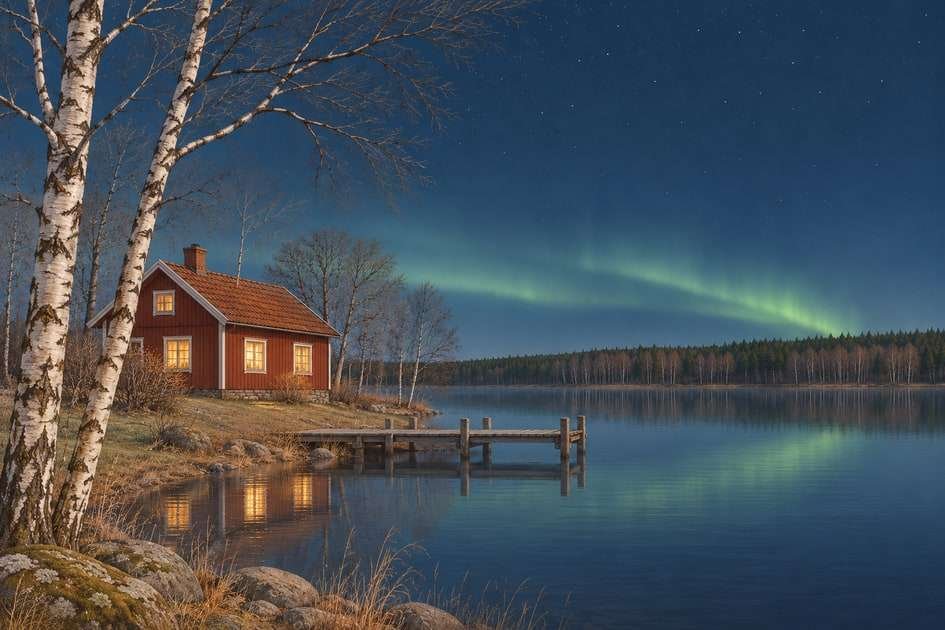
At a glance
The northern lights are sometimes visible in Stockholm and southern Sweden, but a trip here should not depend on a promise of a sighting on one particular evening. You need suitable geomagnetic activity, dark skies, gaps in the clouds and an open northern horizon without strong light pollution. Check these conditions separately and plan your return in advance. Checked 03.11.2026.
Can you see the northern lights in Stockholm and farther south?
Yes, sometimes. With suitable geomagnetic activity, sightings are possible well south of the usual northern auroral zone. However, a city break in Stockholm does not guarantee a sighting. Stockholm is in Svealand; Skåne and other parts of Götaland are considered separately, rather than treated as being at the same latitude. Sources: IRF, SMHI and Visit Sweden, checked 03.11.2026.
IRF explains the northern lights as an interaction between charged particles and the atmosphere. Clouds neither create aurora nor stop it happening in the upper atmosphere: they obstruct the light when viewed from the ground. Visitors therefore need to consider both activity and how much of the sky they can see.
| Check | What it tells you |
|---|---|
| IRF space weather | Activity, not local visibility |
| SMHI weather imagery | Clouds and weather, not aurora |
| NOAA viewing advice | Darkness and an open northern horizon reduce obstacles |
No single indicator guarantees a sighting. Checked 3 November 2026.
When does it make sense to plan a viewing attempt?
Choose the dark part of the day and an evening with a suitable local weather forecast. Autumn and winter trips offer more opportunities to wait for darkness, but the calendar does not schedule the northern lights. Bright summer skies make faint aurora harder to see. Do not apply a northern destination's hours and season to every evening in a southern city. Sources: SMHI and Rymdstyrelsen, 03.11.2026.
IRF's report on the possibility of northern lights over the west coast was published on 04.03.2026. It is a dated example of a possible event in the south, not a forecast for your visit. An old news story cannot replace current information.
Where should you look for a viewing spot in and around Stockholm?
In the centre, returning to your accommodation is easier, but the bright urban background makes faint aurora harder to see. Outside the centre, you may find a darker spot, although trees and buildings can block the part of the sky you need. An open shore or the edge of open countryside is a type of place to assess, not a confirmed viewing site for every evening.
A practical approach is to find a spot with a northern view on the map, check access in daylight, assess lamps and the view in the right direction, then check your transport home. You do not need to walk onto ice or stand beside the carriageway for a better view. Check site rules with the landowner; the name of a nature park does not mean every part is accessible at night. For your general city plans: Stockholm.
What changes in Gothenburg, Skåne and other southern areas?
The basic approach is the same, but a sighting at one latitude does not confirm visibility in another region. On the coast, a broad horizon may come with bright lights, clouds or an awkward journey home at night. Assess the spot and the time, rather than just the region's name. This is a practical conclusion drawn from viewing conditions, not a ranking of places.
Do not book a long overnight journey on the strength of someone else's photograph without its location and time. Aurora over Kiruna and a report from a neighbouring region answer different questions. In the south, prepare several accessible options near your base and choose according to the actual conditions.
How do you check clouds and distinguish them from light pollution?
Open SMHI's weather for your chosen place and time, then look at cloud cover and how it changes. Satellite images help you assess clouds; radar mainly shows precipitation. No rain on the radar does not prove that the sky is clear. Source: SMHI, Radar och satellit, 03.11.2026.
Even when there are stars overhead, the northern horizon may still be covered. Light pollution is a different obstacle: lamps and a city's glow reduce contrast. Look at the sky in your viewing direction, rather than relying only on the general weather icon. Under complete cloud cover, darkness outside the city does not make the sky transparent.
Can you rely on Kp or promises of northern lights tonight?
For current conditions, use the Swedish Institute of Space Physics' space weather centre, distinguishing observations from forecasts. NOAA's short-term OVATION model describes auroral location and intensity, rather than offering an individual guarantee to someone on a city waterfront. Compare the data's timestamp with the current time and its geographic coverage; do not save a map as a forecast that remains valid forever. Source: NOAA's Aurora 30 Minute Forecast product description, 03.11.2026.
How do you prepare for the evening without an unnecessary night journey?
Bring warm layers, a charged phone and a torch for the route. Point the light downwards and avoid disturbing other observers. For seasonal clothing and equipment: What to pack for Sweden by season. For winter planning: Winter safety basics.
Set a time to return and keep an ordinary evening plan as a backup. An unsuccessful attempt does not prove that the forecast was wrong: the phenomenon, local clouds and your view may not coincide.
Updated: 03.11.2026.
Questions and answers
Sometimes, with suitable activity and local conditions. You cannot plan a guaranteed display. IRF and Visit Sweden, 03.11.2026.
The capital is considered separately here: it is in Svealand, whereas Skåne belongs to Götaland. Their conditions should not be treated as identical.
This article is not a live forecast. Before heading out, compare fresh IRF data, SMHI weather and your local view.
There is no universal value that guarantees a sighting at a specific spot. The link between Kp and auroral location is approximate. NOAA, 03.11.2026.
Start with an open northern horizon. Avoid buildings, trees and bright light sources that obstruct or interfere with the view. NOAA, 03.11.2026.
No. The city may remain on the northern horizon, while trees may block your view. Assess the actual direction in which you will be looking.
The index does not remove clouds. Assess local sky visibility separately. SMHI and NOAA, 03.11.2026.
No. Radar mainly shows precipitation; check cloud cover separately, including satellite imagery. SMHI, 03.11.2026.
No, it shows another area. Check the product's geographic coverage and your own horizon.
No. Darkness is only one condition; suitable activity and local visibility are also needed. SMHI, 03.11.2026.
It is more sensible to make viewing a possible addition to a city break. For a dedicated trip, investigate a northern route, but there is no guarantee there either.
No. Choose an accessible spot on land and a safe route back. Do not increase the risk for the sake of a view.
Sources
- IRF: Norrsken. Checked 03.11.2026. The physics of aurora; no guarantee for a particular date.
- IRF: Solstorm kan ge norrsken över Västkusten. Checked 03.11.2026. Published 04.03.2026. A historical example, not a current forecast.
- SMHI: Norrsken. Checked 03.11.2026. Southern sightings are sometimes possible; darkness and relatively clear skies are needed.
- Svenskt rymdvädercentrum, IRF. Checked 03.11.2026. Current products with different observations, forecasts and geographic coverage. No values for today are reproduced here.
- SMHI: Väder. Checked 03.11.2026. Local weather information, not a statement about today's cloud cover.
- SMHI: Radar och satellit. Checked 03.11.2026. The distinction between precipitation radar and satellite cloud imagery.
- NOAA: Tips on Viewing the Aurora. Checked 03.11.2026. The approximate relationship between Kp and location, a northern view and darkness. Current values and dates in the dynamic header are not used.
- NOAA: Aurora 30 Minute Forecast. Checked 03.11.2026. The purpose of the short-term OVATION model. No promise of a local event or live conditions report in this article.
- Rymdstyrelsen: Norrsken. Checked 03.11.2026. Faint light, darkness and clear skies. Nights-per-year statistics are not converted into a probability for a trip.
- Visit Sweden: When and where to see the Northern Lights. Checked 03.11.2026. Occasional southern sightings and urban light pollution. Tour advertising and detailed Abisko material are not reproduced.

Read also

How do you plan ice fishing in Sweden?
Plan ice fishing in Sweden: check access, fishing permits and local restrictions, prepare your equipment and understand the limits of ice checks.
Åre, Sälen, Vemdalen or Idre Fjäll?
Compare Åre, Sälen, Vemdalen and Idre Fjäll for winter 2026/27: season plans, travel, ski passes, rental and a budget for the whole trip.
How do you prepare for safe winter travel in Sweden?
Plan winter travel in Sweden with weather warnings, traffic checks and spare time. Learn what to pack and do during delays, breakdowns or emergencies.
How can you combine Kiruna with a visit to ICEHOTEL?
Plan Kiruna and a visit to ICEHOTEL in Jukkasjärvi. Understand the seasonal and year-round parts, daytime visits and the travel checks to make beforehand.
How can you see the northern lights in Abisko and plan your trip?
Plan an Abisko northern lights trip: choose the season and station, find a viewing spot on land, check SMHI weather and leave room for cloudy nights.
Where can you see the northern lights in Sweden in winter?
Where can you see northern lights in Sweden in winter? Compare four northern bases, check local clouds and space weather, and plan a safe return.
0 comments
Log in to leave a comment